Writes intellectual nonfiction about creativity, literature, and cultural memory.
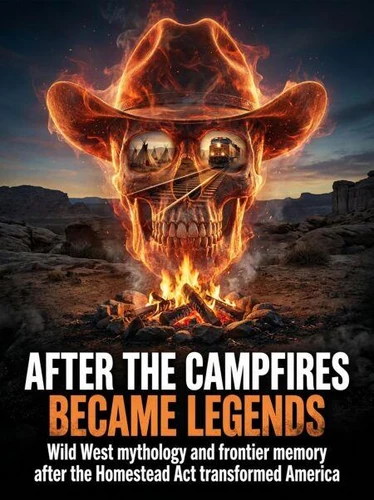
After the Campfires Became Legends. Wild West mythology and frontier memory after the Homestead Act transformed America
Par :Formats :
Disponible dans votre compte client Decitre ou Furet du Nord dès validation de votre commande. Le format ePub est :
- Compatible avec une lecture sur My Vivlio (smartphone, tablette, ordinateur)
- Compatible avec une lecture sur liseuses Vivlio
- Pour les liseuses autres que Vivlio, vous devez utiliser le logiciel Adobe Digital Edition. Non compatible avec la lecture sur les liseuses Kindle, Remarkable et Sony
 , qui est-ce ?
Notre partenaire de plateforme de lecture numérique où vous retrouverez l'ensemble de vos ebooks gratuitement
Pour en savoir plus sur nos ebooks, consultez notre aide en ligne ici
C'est si simple ! Lisez votre ebook avec l'app Vivlio sur votre tablette, mobile ou ordinateur :

- Nombre de pages162
- FormatePub
- ISBN978-3-565-48556-7
- EAN9783565485567
- Date de parution08/06/2026
- Protection num.pas de protection
- Taille981 Ko
- Infos supplémentairesepub
- ÉditeurEmphaloz Publishing House
Résumé
The American West survived twice. First as a violent frontier shaped by migration and dispossession, then again as a national fantasy rebuilt through dime novels, traveling shows, and Hollywood westerns. Between those two versions lies a struggle over who belonged in the story of the frontier at all.
This book examines how Wild West mythology reshaped public memory of the American frontier during the twentieth century.
Popular fiction and cowboy films turned land conflicts into heroic entertainment while minimizing the experiences of Black laborers, immigrant settlers, and Native American communities displaced by federal expansion. At the center of this transformation stood the Homestead Act, whose promises of land ownership accelerated migration while intensifying territorial conflict across the West. Using overlooked diaries, legal records, and community archives, the narrative reconstructs the lived realities behind familiar frontier imagery.
Railroad workers from Asia and Europe, formerly enslaved families seeking economic survival, and Indigenous nations defending political autonomy all encountered a system where federal law determined belonging through property claims and violence. Myth often concealed dependence, instability, and exclusion. The result is not only a reinterpretation of the American West, but a study of how modern nations manufacture memory by deciding whose hardships become legend and whose disappear from view.
Popular fiction and cowboy films turned land conflicts into heroic entertainment while minimizing the experiences of Black laborers, immigrant settlers, and Native American communities displaced by federal expansion. At the center of this transformation stood the Homestead Act, whose promises of land ownership accelerated migration while intensifying territorial conflict across the West. Using overlooked diaries, legal records, and community archives, the narrative reconstructs the lived realities behind familiar frontier imagery.
Railroad workers from Asia and Europe, formerly enslaved families seeking economic survival, and Indigenous nations defending political autonomy all encountered a system where federal law determined belonging through property claims and violence. Myth often concealed dependence, instability, and exclusion. The result is not only a reinterpretation of the American West, but a study of how modern nations manufacture memory by deciding whose hardships become legend and whose disappear from view.
A propos de Natalie Harrington

9,99 €


9,99 €