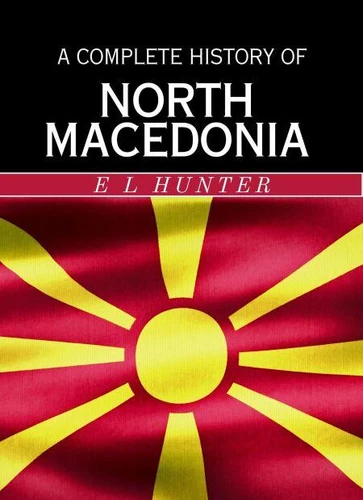
Every nation has a founding story. North Macedonia has several - and its neighbours have their own versions. Claimed at various points by Greece, Bulgaria, and Serbia, the Macedonian people spent much of the modern era being told they did not exist. Their language was called a dialect. Their church was denied recognition for fifty-five years. Their country's name was the subject of a decades-long international dispute that blocked membership in NATO and the European Union. A Complete History of North Macedonia traces the full arc - from prehistoric settlements on the shores of Lake Ohrid through Roman, Byzantine, and Ottoman rule to the revolutionary movements, world wars, and communist federation that shaped the modern state.
It examines how a country of two million people resolved one of Europe's most stubborn disputes, joined a military alliance, and still finds itself waiting at Europe's door. This is the history of a place that has been shaped by forces far larger than itself - and of the people who are still here.
Every nation has a founding story. North Macedonia has several - and its neighbours have their own versions. Claimed at various points by Greece, Bulgaria, and Serbia, the Macedonian people spent much of the modern era being told they did not exist. Their language was called a dialect. Their church was denied recognition for fifty-five years. Their country's name was the subject of a decades-long international dispute that blocked membership in NATO and the European Union. A Complete History of North Macedonia traces the full arc - from prehistoric settlements on the shores of Lake Ohrid through Roman, Byzantine, and Ottoman rule to the revolutionary movements, world wars, and communist federation that shaped the modern state.
It examines how a country of two million people resolved one of Europe's most stubborn disputes, joined a military alliance, and still finds itself waiting at Europe's door. This is the history of a place that has been shaped by forces far larger than itself - and of the people who are still here.

 , qui est-ce ?