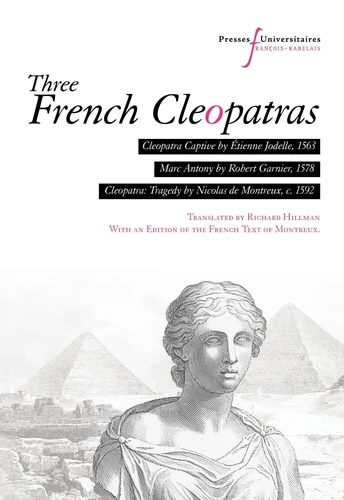
Three French Cleopatras. Cleopatra Captive (Étienne Jodelle, 1563), Marc Antony (Robert Garnier, 1578), Cleopatra: Tragedy (Nicolas de Montreux, c. 1592)
Par :Formats :
- Paiement en ligne :
- Livraison à domicile ou en point Mondial Relay estimée à partir du 30 septembreCet article sera commandé chez un fournisseur et vous sera envoyé 21 jours après la date de votre commande.
- Retrait Click and Collect en magasin gratuit
- FormatGrand Format
- PrésentationBroché
- Poids0.701 kg
- Dimensions14,5 cm × 21,0 cm × 2,3 cm
- ISBN978-2-86906-953-4
- EAN9782869069534
- Date de parution28/11/2024
- CollectionScène européenne
- ÉditeurPU François Rabelais
Résumé
The three dramatisations of the sensational story of Antony and Cleopatra translated here (two for the first time) amount to a significant sub-genre within the current of sixteenth-century French tragedy generally termed "humanist". Etienne Jodelle's Cleopatra Captive (Cleopatre captive) was first performed before Henri II in 1553 and widely recognised as the first neo-classical tragedy in French.
It also served as a reference point for the subsequent treatments of Robert Garnier (1578) and Nicolas de Montreux (c. 1592), which likewise extract from the classical narratives (principally Plutarch) a triangular dynamic of love and power among the three protagonists (Antony, Cleopatra, Octavius Caesar). That dynamic proves susceptible to varying emphases and ambiguous interpretations in a way that documents the developing potential of humanist tragedy itself.
The volume presents these features more clearly thanks to two innovative features. The first is the translation of the work of Garnier, which, apart from the greater accessibility of its modern English, is more respectful of the original, both in form and key details, than the Elizabethan version produced by Mary Sidney Herbert, Countess of Pembroke (Antonius, 1592). Secondly, the volume includes not only the first English translation of the little-known but remarkable tragedy of Montreux, but also, to facilitate access and comparison, the first edition of the French text since its own era, when it was widely diffused.
It also served as a reference point for the subsequent treatments of Robert Garnier (1578) and Nicolas de Montreux (c. 1592), which likewise extract from the classical narratives (principally Plutarch) a triangular dynamic of love and power among the three protagonists (Antony, Cleopatra, Octavius Caesar). That dynamic proves susceptible to varying emphases and ambiguous interpretations in a way that documents the developing potential of humanist tragedy itself.
The volume presents these features more clearly thanks to two innovative features. The first is the translation of the work of Garnier, which, apart from the greater accessibility of its modern English, is more respectful of the original, both in form and key details, than the Elizabethan version produced by Mary Sidney Herbert, Countess of Pembroke (Antonius, 1592). Secondly, the volume includes not only the first English translation of the little-known but remarkable tragedy of Montreux, but also, to facilitate access and comparison, the first edition of the French text since its own era, when it was widely diffused.
A propos de Richard Hillman
20,00 €
Isabelle
Grand Format
28,00 €



20,00 €
Coriolan, by Alexandre Hardy
Grand Format
24,00 €

Diane
Grand Format
28,00 €