

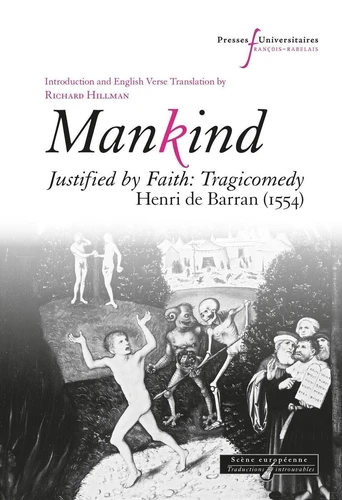
Mankind. Justified by Faith: Tragicomedy. Henri de Barran (1554)
Par : ,Formats :
- Paiement en ligne :
- Livraison à domicile ou en point Mondial Relay estimée à partir du 30 septembreCet article sera commandé chez un fournisseur et vous sera envoyé 21 jours après la date de votre commande.
- Retrait Click and Collect en magasin gratuit
- Nombre de pages136
- FormatGrand Format
- PrésentationBroché
- Poids0.2 kg
- Dimensions14,4 cm × 20,8 cm × 1,1 cm
- ISBN978-2-86906-779-0
- EAN9782869067790
- Date de parution01/07/2021
- CollectionScène européenne
- ÉditeurPU François Rabelais
Résumé
This little-known French moral allegory, published in Protestant Geneva and disparaging the Roman Catholic church on the grounds of both doctrine and practice, serves as an illuminating intertext for various English interludes of the period, as well as for works of the Elizabethan public theatre. Given the negative role of a figure called "Rabbi" as a representative of the Old Law and the motif of cutting open the breast of the universal Mankind figure, the analogues notably include Shakespeare's The Merchant of Venice.
More broadly anticipated is the later drama's development of conscience, in keeping with Reformation theology, as a thoroughly internalised function serving as a pivot between culpability and redemption. Yet doctrinal insistence by no means dampens Barran's dramaturgy, which is far from static. In depicting Mankind's interactions with his spiritual enemies and allies, the author deploys remarkable energy and invention, including moments of mordant verbal and exuberant physical humour, thereby distinguishing himself equally as a polemicist and a playwright.
More broadly anticipated is the later drama's development of conscience, in keeping with Reformation theology, as a thoroughly internalised function serving as a pivot between culpability and redemption. Yet doctrinal insistence by no means dampens Barran's dramaturgy, which is far from static. In depicting Mankind's interactions with his spiritual enemies and allies, the author deploys remarkable energy and invention, including moments of mordant verbal and exuberant physical humour, thereby distinguishing himself equally as a polemicist and a playwright.