
Nouveauté
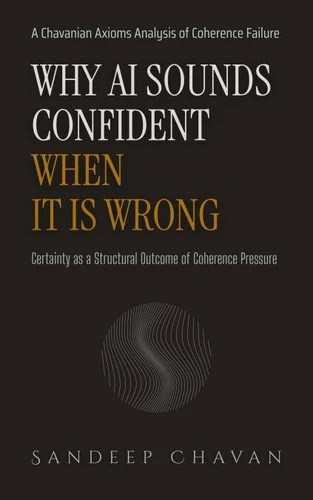
Why AI Sounds Confident When It Is Wrong
Par :Formats :
Disponible dans votre compte client Decitre ou Furet du Nord dès validation de votre commande. Le format ePub protégé est :
- Compatible avec une lecture sur My Vivlio (smartphone, tablette, ordinateur)
- Compatible avec une lecture sur liseuses Vivlio
- Pour les liseuses autres que Vivlio, vous devez utiliser le logiciel Adobe Digital Edition. Non compatible avec la lecture sur les liseuses Kindle, Remarkable et Sony
- Non compatible avec un achat hors France métropolitaine
 , qui est-ce ?
Notre partenaire de plateforme de lecture numérique où vous retrouverez l'ensemble de vos ebooks gratuitement
Pour en savoir plus sur nos ebooks, consultez notre aide en ligne ici
C'est si simple ! Lisez votre ebook avec l'app Vivlio sur votre tablette, mobile ou ordinateur :

- FormatePub
- ISBN8235761094
- EAN9798235761094
- Date de parution18/07/2026
- Protection num.Adobe DRM
- Infos supplémentairesepub
- ÉditeurIoakim Ioakim
Résumé
Why does artificial intelligence sound certain even when it is wrong?The answer is not simply arrogance, deception, or a flaw in tone. Current generative systems do not need human-like belief, pride, or reflective confidence to produce language that appears settled. They need only to transform an open prompt into a finished consequence. In Why AI Sounds Confident When It Is Wrong, Sandeep Chavan examines how computational plurality becomes one visible answer-and how that answer acquires more authority than its underlying support may justify.
Using the Chavanian Axioms as a structural diagnostic lens, the book follows the movement from difference and resolution through geometry, collapse, residue, irreversibility, continuity, human interpretation, and institutional action. The analysis distinguishes hallucination from artificial confidence. Hallucination concerns unsupported or fabricated content. Artificial confidence concerns why generated content-whether correct, incomplete, outdated, or false-arrives in a form associated with knowledge.
Fluency, specificity, citations, calculations, retrieval tools, confidence scores, and human review can all strengthen an answer without necessarily completing the epistemic circuit required for truth. Across sixteen chapters and four interludes, the book examines how users imagine a knowing speaker behind generated language; why token probability and linguistic coherence are not the same as factual certainty; how decoding compresses many possible continuations into one visible path; and what assumptions, alternatives, and unresolved differences remain outside the completed answer.
It follows AI-generated output beyond the conversation, showing how a sentence can enter memory, documents, meetings, workflows, automated decisions, and institutional history. Once an answer becomes part of the surrounding field, correction cannot simply restore the conditions that existed before it appeared. The book also investigates how scaling, reward shaping, retrieval, tools, and automation amplify the appearance of certainty.
It explains why attaching a source does not automatically validate an inference, why a correct calculation can answer the wrong problem, and why a human in the loop is not enough unless that person possesses evidence, expertise, independence, time, authority, and responsibility. The final sections explore how artificial intelligence systems may preserve functional restraint without pretending that machines have acquired reflective humility.
The aim is not to make every answer hesitant, but to keep meaningful uncertainty visible where missing information, disputed interpretation, weak grounding, or serious consequences make immediate closure unsafe. This is not an anti-AI book. It recognizes artificial intelligence as a powerful resolution technology capable of widening access to explanation, supporting research, strengthening education, and accelerating human work.
Its concern is proportionate authority: what an AI-generated answer should be allowed to become before its connection to evidence, scope, context, consequence, and correction has been established. Written for AI users, researchers, educators, professionals, policymakers, institutional leaders, and readers concerned with the future of knowledge, Why AI Sounds Confident When It Is Wrong offers a rigorous framework for understanding why confident error is not located inside the model alone.
It emerges across a confidence circuit linking generation, interface, perception, trust, and action. The central distinction is simple:Confidence is compression. Truth requires connection.
Using the Chavanian Axioms as a structural diagnostic lens, the book follows the movement from difference and resolution through geometry, collapse, residue, irreversibility, continuity, human interpretation, and institutional action. The analysis distinguishes hallucination from artificial confidence. Hallucination concerns unsupported or fabricated content. Artificial confidence concerns why generated content-whether correct, incomplete, outdated, or false-arrives in a form associated with knowledge.
Fluency, specificity, citations, calculations, retrieval tools, confidence scores, and human review can all strengthen an answer without necessarily completing the epistemic circuit required for truth. Across sixteen chapters and four interludes, the book examines how users imagine a knowing speaker behind generated language; why token probability and linguistic coherence are not the same as factual certainty; how decoding compresses many possible continuations into one visible path; and what assumptions, alternatives, and unresolved differences remain outside the completed answer.
It follows AI-generated output beyond the conversation, showing how a sentence can enter memory, documents, meetings, workflows, automated decisions, and institutional history. Once an answer becomes part of the surrounding field, correction cannot simply restore the conditions that existed before it appeared. The book also investigates how scaling, reward shaping, retrieval, tools, and automation amplify the appearance of certainty.
It explains why attaching a source does not automatically validate an inference, why a correct calculation can answer the wrong problem, and why a human in the loop is not enough unless that person possesses evidence, expertise, independence, time, authority, and responsibility. The final sections explore how artificial intelligence systems may preserve functional restraint without pretending that machines have acquired reflective humility.
The aim is not to make every answer hesitant, but to keep meaningful uncertainty visible where missing information, disputed interpretation, weak grounding, or serious consequences make immediate closure unsafe. This is not an anti-AI book. It recognizes artificial intelligence as a powerful resolution technology capable of widening access to explanation, supporting research, strengthening education, and accelerating human work.
Its concern is proportionate authority: what an AI-generated answer should be allowed to become before its connection to evidence, scope, context, consequence, and correction has been established. Written for AI users, researchers, educators, professionals, policymakers, institutional leaders, and readers concerned with the future of knowledge, Why AI Sounds Confident When It Is Wrong offers a rigorous framework for understanding why confident error is not located inside the model alone.
It emerges across a confidence circuit linking generation, interface, perception, trust, and action. The central distinction is simple:Confidence is compression. Truth requires connection.
A propos de SANDEEP CHAVAN


34,99 €
21,99 €

34,99 €
Theory of Perception
E-book
21,99 €
Consciousness
E-book
35,49 €
35,49 €







Chavanian Power Theory
E-book
34,99 €

The Center of Mass
E-book
21,99 €

21,99 €

21,99 €
35,49 €

21,99 €