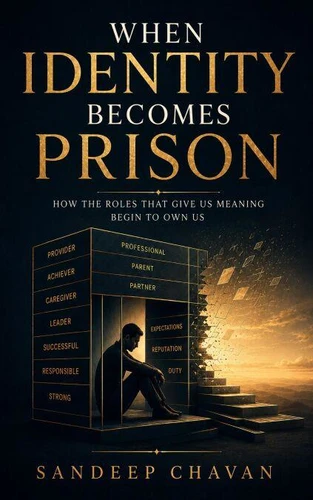
The roles that give us meaning can also become the roles we no longer know how to leave. A teacher becomes more than someone who teaches. A parent becomes the one who must always sacrifice. A provider becomes valuable mainly through income. A leader becomes unable to step away from the centre. A caregiver becomes responsible for everyone while receiving little care in return. A competent professional becomes indispensable-and slowly loses the freedom to become anything else.
When Identity Becomes Prison: How the Roles That Give Us Meaning Begin to Own Us is a deeply reflective book about role identity, self-worth, responsibility, emotional boundaries, social expectations, and personal transformation. Identity is not presented here as an enemy. Roles give us direction, dignity, income, belonging, structure, and a place in the world. They connect our abilities with real human needs.
The problem begins when one role becomes too powerful-when it stops describing part of life and starts defining the whole person. Through clear psychological insight, social observation, and practical reflection, Sandeep Chavan explores how identity becomes restrictive through repetition, usefulness, success, appreciation, guilt, dependence, reputation, and responsibility. The book asks difficult but necessary questions: Why do responsible people remain in roles that exhaust them? Why does being needed become emotionally addictive? Why can success create stronger identity walls than failure? Why do families, institutions, audiences, and communities resist our transformation? Why does reducing responsibility feel like betrayal? Who are we when the role becomes quiet? And can we become larger without abandoning the people and duties connected to us? The book moves through five stages.
First, it explains why identity initially saves us by creating coherence and belonging. It then shows how the role hardens through appreciation, competence, dependence, and social expectation. From there, it examines how others begin owning the version of us they need, and how the outer prison eventually becomes an inner one maintained by ego, guilt, loyalty, and fear. The final section introduces the book's central alternative: expansion without escape.
Freedom does not always require resignation, retirement, rebellion, or destruction. A person may remain a teacher while becoming a writer. A parent may continue caring while reclaiming an individual life. A provider may remain responsible while becoming a creator. A leader may step back without disappearing. A professional may preserve income while developing another centre of meaning. The goal is not to reject identity, but to make it flexible, layered, bounded, and revisable.
With practical appendices on signs of identity captivity, reflective questions, responsible transition, and common identity prisons, this book offers readers both insight and a framework for change. It is especially relevant for teachers, parents, providers, professionals, caregivers, leaders, business owners, creators, public figures, and anyone who has become known primarily through what they do for others.
This is not a book about abandoning responsibility. It is about preventing responsibility from erasing the person carrying it. The role may belong to your life. Your life must not belong entirely to the role.
The roles that give us meaning can also become the roles we no longer know how to leave. A teacher becomes more than someone who teaches. A parent becomes the one who must always sacrifice. A provider becomes valuable mainly through income. A leader becomes unable to step away from the centre. A caregiver becomes responsible for everyone while receiving little care in return. A competent professional becomes indispensable-and slowly loses the freedom to become anything else.
When Identity Becomes Prison: How the Roles That Give Us Meaning Begin to Own Us is a deeply reflective book about role identity, self-worth, responsibility, emotional boundaries, social expectations, and personal transformation. Identity is not presented here as an enemy. Roles give us direction, dignity, income, belonging, structure, and a place in the world. They connect our abilities with real human needs.
The problem begins when one role becomes too powerful-when it stops describing part of life and starts defining the whole person. Through clear psychological insight, social observation, and practical reflection, Sandeep Chavan explores how identity becomes restrictive through repetition, usefulness, success, appreciation, guilt, dependence, reputation, and responsibility. The book asks difficult but necessary questions: Why do responsible people remain in roles that exhaust them? Why does being needed become emotionally addictive? Why can success create stronger identity walls than failure? Why do families, institutions, audiences, and communities resist our transformation? Why does reducing responsibility feel like betrayal? Who are we when the role becomes quiet? And can we become larger without abandoning the people and duties connected to us? The book moves through five stages.
First, it explains why identity initially saves us by creating coherence and belonging. It then shows how the role hardens through appreciation, competence, dependence, and social expectation. From there, it examines how others begin owning the version of us they need, and how the outer prison eventually becomes an inner one maintained by ego, guilt, loyalty, and fear. The final section introduces the book's central alternative: expansion without escape.
Freedom does not always require resignation, retirement, rebellion, or destruction. A person may remain a teacher while becoming a writer. A parent may continue caring while reclaiming an individual life. A provider may remain responsible while becoming a creator. A leader may step back without disappearing. A professional may preserve income while developing another centre of meaning. The goal is not to reject identity, but to make it flexible, layered, bounded, and revisable.
With practical appendices on signs of identity captivity, reflective questions, responsible transition, and common identity prisons, this book offers readers both insight and a framework for change. It is especially relevant for teachers, parents, providers, professionals, caregivers, leaders, business owners, creators, public figures, and anyone who has become known primarily through what they do for others.
This is not a book about abandoning responsibility. It is about preventing responsibility from erasing the person carrying it. The role may belong to your life. Your life must not belong entirely to the role.

 , qui est-ce ?