SOLDES
Jusqu'à -70% sur une sélection d'articles*

Nouveauté
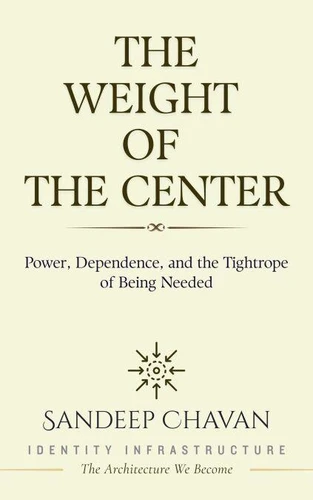
The Weight of the Center. Identity Infrastructure: The Architecture We Become, #4
Par :Formats :
Disponible dans votre compte client Decitre ou Furet du Nord dès validation de votre commande. Le format ePub protégé est :
- Compatible avec une lecture sur My Vivlio (smartphone, tablette, ordinateur)
- Compatible avec une lecture sur liseuses Vivlio
- Pour les liseuses autres que Vivlio, vous devez utiliser le logiciel Adobe Digital Edition. Non compatible avec la lecture sur les liseuses Kindle, Remarkable et Sony
- Non compatible avec un achat hors France métropolitaine
 , qui est-ce ?
Notre partenaire de plateforme de lecture numérique où vous retrouverez l'ensemble de vos ebooks gratuitement
Pour en savoir plus sur nos ebooks, consultez notre aide en ligne ici
C'est si simple ! Lisez votre ebook avec l'app Vivlio sur votre tablette, mobile ou ordinateur :

- FormatePub
- ISBN8235770775
- EAN9798235770775
- Date de parution16/07/2026
- Protection num.Adobe DRM
- Infos supplémentairesepub
- ÉditeurIoakim Ioakim
Résumé
Power is usually imagined as possession: a title, office, resource, command, or authority held by someone at the center. The Weight of the Center offers a different account. Power appears where a field repeatedly achieves consequence through a node-and the more the field resolves through that node, the more powerful and less free it becomes. In this fourth volume of the Identity Infrastructure series, Sandeep Chavan examines how successful resolution gradually creates centrality.
A person, role, institution, platform, city, technology, or system first becomes useful because it carries an unresolved condition. Repeated consequence then draws questions, information, decisions, trust, conflict, resources, and responsibility toward the same point. The field reorganizes around the center's continued availability. What begins as efficiency can become dependence. The center learns more because more arrives there.
Surrounding nodes learn less because difficult judgment is repeatedly transferred away from them. The center becomes increasingly capable, while the field becomes less practised in carrying uncertainty, failure, conflict, and consequence elsewhere. Eventually, absence reveals the hidden architecture: decisions wait, procedures lose meaning, confidence declines, and the field discovers that its apparent strength depended upon one continuously available node.
The Weight of the Center develops a cross-domain theory of resolution centers, operative centrality, concentrated consequence, responsibility accumulation, reduced freedom, bottlenecks, weak alternative nodes, succession vulnerability, and overcentralization. It explains why influence often feels less like freedom from within the center, why indispensable people become trapped by the very dependence that confirms their importance, and how highly successful systems can become structurally fragile.
Moving across families, classrooms, organizations, institutions, political fields, cities, technologies, networks, and machines, the book asks a decisive question:What has the field stopped learning because the center remained dependable?This is not an argument against leadership, expertise, authority, or concentration. Fields need centers. The deeper issue is whether a center strengthens the field's capacity to resolve-or gradually becomes the only route through which resolution can occur.
Part of the six-volume Identity Infrastructure series, The Weight of the Center is a rigorous philosophical and structural study of power, dependence, responsibility, leadership burden, organizational fragility, and the hidden cost of being needed.
A person, role, institution, platform, city, technology, or system first becomes useful because it carries an unresolved condition. Repeated consequence then draws questions, information, decisions, trust, conflict, resources, and responsibility toward the same point. The field reorganizes around the center's continued availability. What begins as efficiency can become dependence. The center learns more because more arrives there.
Surrounding nodes learn less because difficult judgment is repeatedly transferred away from them. The center becomes increasingly capable, while the field becomes less practised in carrying uncertainty, failure, conflict, and consequence elsewhere. Eventually, absence reveals the hidden architecture: decisions wait, procedures lose meaning, confidence declines, and the field discovers that its apparent strength depended upon one continuously available node.
The Weight of the Center develops a cross-domain theory of resolution centers, operative centrality, concentrated consequence, responsibility accumulation, reduced freedom, bottlenecks, weak alternative nodes, succession vulnerability, and overcentralization. It explains why influence often feels less like freedom from within the center, why indispensable people become trapped by the very dependence that confirms their importance, and how highly successful systems can become structurally fragile.
Moving across families, classrooms, organizations, institutions, political fields, cities, technologies, networks, and machines, the book asks a decisive question:What has the field stopped learning because the center remained dependable?This is not an argument against leadership, expertise, authority, or concentration. Fields need centers. The deeper issue is whether a center strengthens the field's capacity to resolve-or gradually becomes the only route through which resolution can occur.
Part of the six-volume Identity Infrastructure series, The Weight of the Center is a rigorous philosophical and structural study of power, dependence, responsibility, leadership burden, organizational fragility, and the hidden cost of being needed.
A propos de SANDEEP CHAVAN


34,99 €




Chavanian Power Theory
E-book
34,99 €

The Center of Mass
E-book
21,99 €

21,99 €

21,99 €
35,49 €

21,99 €

From Synapse to Self
E-book
21,99 €

17,49 €

What Is Scattering You?
E-book
17,49 €

Physics of Love & Sex
E-book
21,99 €

34,99 €

The Mind That Won’t Stop
E-book
17,49 €

21,99 €

Constitutional Geometry
E-book
34,99 €