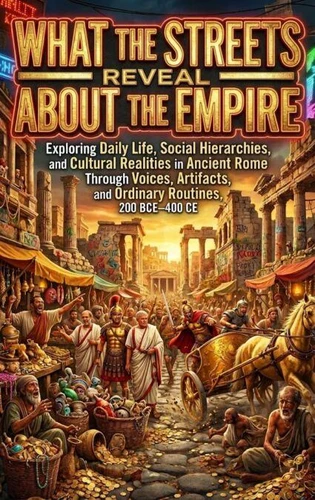
What the Streets Reveal About the Empire. Exploring Daily Life, Social Hierarchies, and Cultural Realities in Ancient Rome Through Voices, Artifacts, and Ordinary Routines, 200 BCE–400 CE
Par :Formats :
Disponible dans votre compte client Decitre ou Furet du Nord dès validation de votre commande. Le format ePub est :
- Compatible avec une lecture sur My Vivlio (smartphone, tablette, ordinateur)
- Compatible avec une lecture sur liseuses Vivlio
- Pour les liseuses autres que Vivlio, vous devez utiliser le logiciel Adobe Digital Edition. Non compatible avec la lecture sur les liseuses Kindle, Remarkable et Sony
 , qui est-ce ?
Notre partenaire de plateforme de lecture numérique où vous retrouverez l'ensemble de vos ebooks gratuitement
Pour en savoir plus sur nos ebooks, consultez notre aide en ligne ici
C'est si simple ! Lisez votre ebook avec l'app Vivlio sur votre tablette, mobile ou ordinateur :

- Nombre de pages222
- FormatePub
- ISBN978-3-565-19864-1
- EAN9783565198641
- Date de parution27/01/2026
- Protection num.pas de protection
- Taille2 Mo
- Infos supplémentairesepub
- ÉditeurEmphaloz Publishing House
Résumé
Beyond the marble monuments and imperial proclamations lies a different Rome-one shaped by the smell of bakeries at dawn, the noise of apartment buildings, the calculations of merchants in the forum, and the unspoken rules governing who could speak, move, or eat where.
This book reconstructs daily existence across Rome's social spectrum, from senators negotiating political alliances over dinner to enslaved workers maintaining urban infrastructure, from women managing households within restrictive legal frameworks to immigrant communities preserving cultural practices in crowded neighborhoods.
It asks: what did an ordinary day actually look like for people whose lives were never meant to be remembered? Drawing on archaeological finds-graffiti, kitchen tools, skeletal remains, tenant contracts, personal letters-it traces how social hierarchies were performed in clothing choices, enforced through spatial segregation, and occasionally challenged in tavern conversations. It examines how religious festivals structured time, how bathing rituals created temporary social mixing, how diet reflected both geography and status, and how entertainment-from chariot races to gladiatorial games-reinforced imperial ideology while offering moments of collective experience. This is not a romanticized portrait of ancient grandeur, but an excavation of the textures, tensions, and compromises that defined existence within a vast, unequal, yet remarkably interconnected empire.
It asks: what did an ordinary day actually look like for people whose lives were never meant to be remembered? Drawing on archaeological finds-graffiti, kitchen tools, skeletal remains, tenant contracts, personal letters-it traces how social hierarchies were performed in clothing choices, enforced through spatial segregation, and occasionally challenged in tavern conversations. It examines how religious festivals structured time, how bathing rituals created temporary social mixing, how diet reflected both geography and status, and how entertainment-from chariot races to gladiatorial games-reinforced imperial ideology while offering moments of collective experience. This is not a romanticized portrait of ancient grandeur, but an excavation of the textures, tensions, and compromises that defined existence within a vast, unequal, yet remarkably interconnected empire.