Celeste Rowan is a nonfiction author known for writing reflective books on mindfulness, emotional resilience, and intentional living. Her calm and thoughtful approach blends psychology, philosophy, and everyday wisdom to help readers cultivate greater balance, clarity, and inner peace.
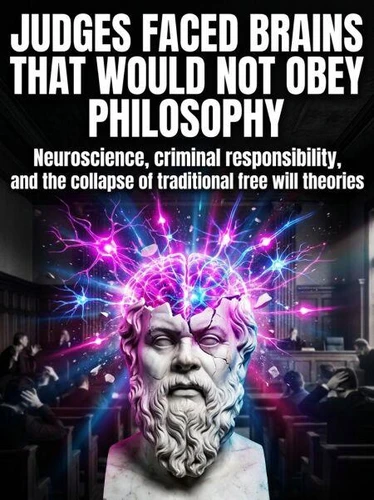
Judges Faced Brains That Would Not Obey Philosophy. Neuroscience, criminal responsibility, and the collapse of traditional free will theories
Par :Formats :
Disponible dans votre compte client Decitre ou Furet du Nord dès validation de votre commande. Le format ePub est :
- Compatible avec une lecture sur My Vivlio (smartphone, tablette, ordinateur)
- Compatible avec une lecture sur liseuses Vivlio
- Pour les liseuses autres que Vivlio, vous devez utiliser le logiciel Adobe Digital Edition. Non compatible avec la lecture sur les liseuses Kindle, Remarkable et Sony
 , qui est-ce ?
Notre partenaire de plateforme de lecture numérique où vous retrouverez l'ensemble de vos ebooks gratuitement
Pour en savoir plus sur nos ebooks, consultez notre aide en ligne ici
C'est si simple ! Lisez votre ebook avec l'app Vivlio sur votre tablette, mobile ou ordinateur :

- Nombre de pages200
- FormatePub
- ISBN978-3-565-47768-5
- EAN9783565477685
- Date de parution05/06/2026
- Protection num.pas de protection
- Taille932 Ko
- Infos supplémentairesepub
- ÉditeurEmphaloz Publishing House
Résumé
Modern law was built on the assumption that individuals consciously choose their actions. Neuroscience has complicated that foundation by demonstrating how trauma, neural damage, and unconscious processing shape behavior before conscious awareness fully emerges. The courtroom now confronts questions once confined to philosophy.
This account explores the collision between neuroscience and legal responsibility in the twenty-first century.
Studies of traumatic brain injury, impulse regulation, and decision-making increasingly challenge older ideas of autonomous free will. Brain imaging technologies reveal how neurological abnormalities can alter aggression, empathy, memory, and moral judgment in ways difficult to reconcile with traditional criminal punishment. The book also examines the philosophical debate surrounding consciousness itself.
Materialist theories argue that awareness emerges from physical computation within neural systems rather than from any nonmaterial mind. If human choices arise from biological mechanisms shaped by genetics and environment, modern justice systems may require fundamental reconsideration. Beyond criminal law, these discoveries carry major implications for medical ethics and long-term care. Patients with severe brain trauma now occupy uncertain territory between consciousness, reflex, and identity.
Neuroscience therefore forces societies to reconsider not only guilt and responsibility, but what qualifies as a person at all.
Studies of traumatic brain injury, impulse regulation, and decision-making increasingly challenge older ideas of autonomous free will. Brain imaging technologies reveal how neurological abnormalities can alter aggression, empathy, memory, and moral judgment in ways difficult to reconcile with traditional criminal punishment. The book also examines the philosophical debate surrounding consciousness itself.
Materialist theories argue that awareness emerges from physical computation within neural systems rather than from any nonmaterial mind. If human choices arise from biological mechanisms shaped by genetics and environment, modern justice systems may require fundamental reconsideration. Beyond criminal law, these discoveries carry major implications for medical ethics and long-term care. Patients with severe brain trauma now occupy uncertain territory between consciousness, reflex, and identity.
Neuroscience therefore forces societies to reconsider not only guilt and responsibility, but what qualifies as a person at all.