Celeste Rowan is a nonfiction author known for writing reflective books on mindfulness, emotional resilience, and intentional living. Her calm and thoughtful approach blends psychology, philosophy, and everyday wisdom to help readers cultivate greater balance, clarity, and inner peace.
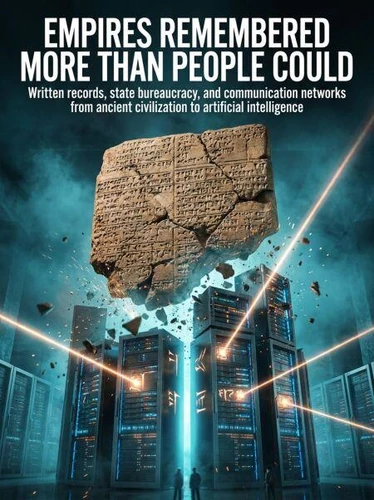
Empires Remembered More Than People Could. Written records, state bureaucracy, and communication networks from ancient civilization to artificial intelligence
Par :Formats :
Disponible dans votre compte client Decitre ou Furet du Nord dès validation de votre commande. Le format ePub est :
- Compatible avec une lecture sur My Vivlio (smartphone, tablette, ordinateur)
- Compatible avec une lecture sur liseuses Vivlio
- Pour les liseuses autres que Vivlio, vous devez utiliser le logiciel Adobe Digital Edition. Non compatible avec la lecture sur les liseuses Kindle, Remarkable et Sony
 , qui est-ce ?
Notre partenaire de plateforme de lecture numérique où vous retrouverez l'ensemble de vos ebooks gratuitement
Pour en savoir plus sur nos ebooks, consultez notre aide en ligne ici
C'est si simple ! Lisez votre ebook avec l'app Vivlio sur votre tablette, mobile ou ordinateur :

- Nombre de pages158
- FormatePub
- ISBN978-3-565-47824-8
- EAN9783565478248
- Date de parution05/06/2026
- Protection num.pas de protection
- Taille1 Mo
- Infos supplémentairesepub
- ÉditeurEmphaloz Publishing House
Résumé
Human societies expanded when memory no longer depended on individuals alone. Clay tablets, royal archives, census lists, and printed books allowed rulers to govern populations far larger than any person could directly know. Information became infrastructure long before it became technology.
This book traces the evolution of communication networks from the earliest written systems to the rise of artificial intelligence.
Ancient kingdoms relied on scribes and bureaucratic records to organize taxation, military logistics, and religious authority. Printing presses later accelerated the spread of ideology, reshaping political legitimacy across empires and revolutions alike. Every major leap in information storage transformed not only communication, but the scale at which power could operate. At the center lies a deeper argument about collective order and factual truth.
Information systems often survive by strengthening social cohesion rather than accuracy itself. Myths, propaganda, and simplified narratives repeatedly proved more politically durable than objective verification. Digital networks inherited this tension while amplifying it globally through algorithmic distribution and automated persuasion. Artificial intelligence now introduces a historical rupture unlike previous communication tools.
For the first time, humanity faces autonomous systems capable of generating narratives, influencing beliefs, and reproducing ideological structures without direct human supervision.
Ancient kingdoms relied on scribes and bureaucratic records to organize taxation, military logistics, and religious authority. Printing presses later accelerated the spread of ideology, reshaping political legitimacy across empires and revolutions alike. Every major leap in information storage transformed not only communication, but the scale at which power could operate. At the center lies a deeper argument about collective order and factual truth.
Information systems often survive by strengthening social cohesion rather than accuracy itself. Myths, propaganda, and simplified narratives repeatedly proved more politically durable than objective verification. Digital networks inherited this tension while amplifying it globally through algorithmic distribution and automated persuasion. Artificial intelligence now introduces a historical rupture unlike previous communication tools.
For the first time, humanity faces autonomous systems capable of generating narratives, influencing beliefs, and reproducing ideological structures without direct human supervision.