
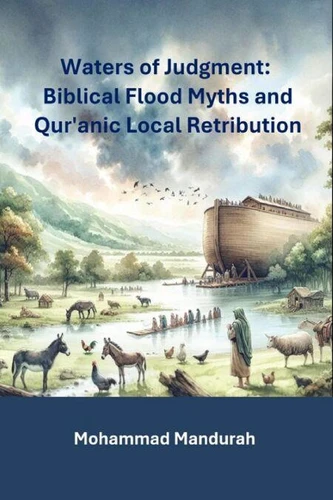
Waters of Judgment. Biblical Flood Myths and Qur'anic Local Retribution
Par :Formats :
Disponible dans votre compte client Decitre ou Furet du Nord dès validation de votre commande. Le format ePub est :
- Compatible avec une lecture sur My Vivlio (smartphone, tablette, ordinateur)
- Compatible avec une lecture sur liseuses Vivlio
- Pour les liseuses autres que Vivlio, vous devez utiliser le logiciel Adobe Digital Edition. Non compatible avec la lecture sur les liseuses Kindle, Remarkable et Sony
 , qui est-ce ?
Notre partenaire de plateforme de lecture numérique où vous retrouverez l'ensemble de vos ebooks gratuitement
Pour en savoir plus sur nos ebooks, consultez notre aide en ligne ici
C'est si simple ! Lisez votre ebook avec l'app Vivlio sur votre tablette, mobile ou ordinateur :

- FormatePub
- ISBN8231532025
- EAN9798231532025
- Date de parution27/07/2025
- Protection num.pas de protection
- Infos supplémentairesepub
- ÉditeurWalzone Press
Résumé
Waters of Judgment: Biblical Flood Myths and Qur'anic Local RetributionDiscover the untold story behind one of humanity's most iconic narratives-the flood. Waters of Judgment is a groundbreaking work that takes you on a journey through ancient texts, scientific discoveries, and cultural history to uncover the deeper meanings of the Biblical and Qur'anic flood stories. Dr. Mohammad M. Mandurah presents a bold and thought-provoking analysis, challenging traditional interpretations while offering fresh insights into theology, history, and science.
In this meticulously researched book, Dr. Mandurah explores: The Genesis Flood vs. Nuh's Flood: The Bible describes a global catastrophe that eradicated all life except for Noah and those aboard the Ark, while the Qur'an presents Nuh's flood as a localized event targeting a disbelieving community. This comparison reveals profound theological differences, emphasizing the Qur'an's clarity and focus on moral accountability.
Scientific Evidence: Drawing on geology, hydrology, biology, and climatology, the book explains why modern science overwhelmingly refutes the possibility of a global flood as described in Genesis. The absence of uniform sediment layers, insufficient water volume, and the impossibility of rapid ecosystem recovery are explored in detail. In contrast, the Qur'an's localized depiction aligns with scientific findings, offering a narrative free from contradictions.
Cultural Influences: The Genesis flood narrative shares striking similarities with earlier Ancient Near Eastern myths, such as the Epic of Gilgamesh and Atrahasis. Dr. Mandurah traces how these regional myths, shaped by Mesopotamian culture, influenced the biblical account during the Babylonian Exile and earlier interactions with Canaanite traditions. Theological Clarity: The Qur'an emphasizes divine justice, proportional punishment, and individual accountability, avoiding the logistical and scientific challenges of a global flood.
Its focus on moral lessons and prophetic warnings offers a unique perspective that resonates with contemporary readers. Why This Book MattersWaters of Judgment isn't just a comparison of two ancient texts-it's a deep exploration of humanity's relationship with the divine, the consequences of disobedience, and the quest for renewal. By bridging theology, science, and history, this book provides a fresh lens for understanding one of history's most enduring tales.
Who Should Read This Book? Scholars and Students: Perfect for those studying theology, comparative religion, or ancient history, offering a multidisciplinary approach to the flood narratives. Believers and Seekers: A thought-provoking resource for anyone interested in the intersection of faith and science, or seeking clarity on religious teachings. Curious Readers: Accessible and engaging, this book invites readers to explore timeless themes of divine justice, moral accountability, and human resilience.
In this meticulously researched book, Dr. Mandurah explores: The Genesis Flood vs. Nuh's Flood: The Bible describes a global catastrophe that eradicated all life except for Noah and those aboard the Ark, while the Qur'an presents Nuh's flood as a localized event targeting a disbelieving community. This comparison reveals profound theological differences, emphasizing the Qur'an's clarity and focus on moral accountability.
Scientific Evidence: Drawing on geology, hydrology, biology, and climatology, the book explains why modern science overwhelmingly refutes the possibility of a global flood as described in Genesis. The absence of uniform sediment layers, insufficient water volume, and the impossibility of rapid ecosystem recovery are explored in detail. In contrast, the Qur'an's localized depiction aligns with scientific findings, offering a narrative free from contradictions.
Cultural Influences: The Genesis flood narrative shares striking similarities with earlier Ancient Near Eastern myths, such as the Epic of Gilgamesh and Atrahasis. Dr. Mandurah traces how these regional myths, shaped by Mesopotamian culture, influenced the biblical account during the Babylonian Exile and earlier interactions with Canaanite traditions. Theological Clarity: The Qur'an emphasizes divine justice, proportional punishment, and individual accountability, avoiding the logistical and scientific challenges of a global flood.
Its focus on moral lessons and prophetic warnings offers a unique perspective that resonates with contemporary readers. Why This Book MattersWaters of Judgment isn't just a comparison of two ancient texts-it's a deep exploration of humanity's relationship with the divine, the consequences of disobedience, and the quest for renewal. By bridging theology, science, and history, this book provides a fresh lens for understanding one of history's most enduring tales.
Who Should Read This Book? Scholars and Students: Perfect for those studying theology, comparative religion, or ancient history, offering a multidisciplinary approach to the flood narratives. Believers and Seekers: A thought-provoking resource for anyone interested in the intersection of faith and science, or seeking clarity on religious teachings. Curious Readers: Accessible and engaging, this book invites readers to explore timeless themes of divine justice, moral accountability, and human resilience.
A propos de Mohammad Mandurah
5,49 €




4,99 €

7,49 €