
Nouveauté
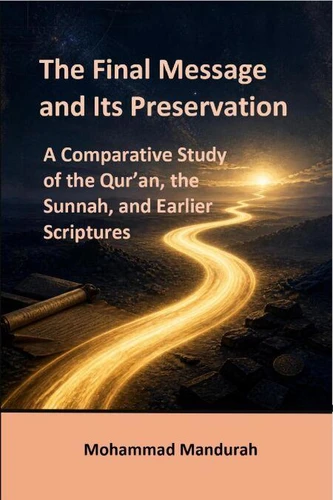
The Final Message and Its Preservation: A Comparative Study of the Qur’an, the Sunnah, and Earlier Scriptures
Par :Formats :
Disponible dans votre compte client Decitre ou Furet du Nord dès validation de votre commande. Le format ePub est :
- Compatible avec une lecture sur My Vivlio (smartphone, tablette, ordinateur)
- Compatible avec une lecture sur liseuses Vivlio
- Pour les liseuses autres que Vivlio, vous devez utiliser le logiciel Adobe Digital Edition. Non compatible avec la lecture sur les liseuses Kindle, Remarkable et Sony
 , qui est-ce ?
Notre partenaire de plateforme de lecture numérique où vous retrouverez l'ensemble de vos ebooks gratuitement
Pour en savoir plus sur nos ebooks, consultez notre aide en ligne ici
C'est si simple ! Lisez votre ebook avec l'app Vivlio sur votre tablette, mobile ou ordinateur :

- FormatePub
- ISBN8235437739
- EAN9798235437739
- Date de parution21/06/2026
- Protection num.pas de protection
- Infos supplémentairesepub
- ÉditeurIoakim Ioakim
Résumé
If God has spoken to humanity, how can we know what He said-and whether His message has been preserved? The Final Message and Its Preservation is a thought-provoking study written for readers who are willing to ask one of religion's most important and neglected questions: not simply whether revelation exists, but whether divine guidance has remained accessible, identifiable, and trustworthy across history.
In this carefully argued work, Mohammad Mandurah examines the transmission of the Qur'an, the Sunnah, the Torah, and the New Testament, bringing together theology, history, and comparative analysis in a clear and accessible way. Rather than approaching scripture only as a matter of faith, identity, or inherited tradition, this book asks how sacred texts were actually preserved. How were they recited, memorized, written, copied, collected, and canonized? What is the difference between manuscript evidence and named chains of transmission? What happens when authorship becomes uncertain, source layers are reconstructed, or the path from revelation to later text grows difficult to trace? Drawing on the Islamic intellectual tradition, the book argues that Islam presents a uniquely coherent account of preserved revelation.
It explores the Qur'an's gradual revelation during the lifetime of Prophet Muhammad ?, its public recitation, broad memorization, written recording by known scribes, early collection under Abu Bakr, standardization under ?Uthman, and preservation through the canonical qira?at. It also examines the preservation of the Sunnah through the sciences of isnad, ?ilm al-rijal, jar? wa-ta?dil, hadith classification, and the detection of hidden defects. At the same time, the book treats earlier scriptures with seriousness and respect.
It surveys the traditional and modern questions surrounding Mosaic authorship, the Documentary Hypothesis, Torah transmission, Gospel authorship, New Testament manuscripts, textual criticism, and canon formation-without caricature or polemic. Written for sincere truth seekers, students of religion, and thoughtful non-Muslim readers, The Final Message and Its Preservation offers more than a comparison of books.
It presents a challenge: if God's final guidance was meant for all people and all times, what would its preservation need to look like? This book argues that final revelation would have to be preserved-and that Islam uniquely claims exactly that.
In this carefully argued work, Mohammad Mandurah examines the transmission of the Qur'an, the Sunnah, the Torah, and the New Testament, bringing together theology, history, and comparative analysis in a clear and accessible way. Rather than approaching scripture only as a matter of faith, identity, or inherited tradition, this book asks how sacred texts were actually preserved. How were they recited, memorized, written, copied, collected, and canonized? What is the difference between manuscript evidence and named chains of transmission? What happens when authorship becomes uncertain, source layers are reconstructed, or the path from revelation to later text grows difficult to trace? Drawing on the Islamic intellectual tradition, the book argues that Islam presents a uniquely coherent account of preserved revelation.
It explores the Qur'an's gradual revelation during the lifetime of Prophet Muhammad ?, its public recitation, broad memorization, written recording by known scribes, early collection under Abu Bakr, standardization under ?Uthman, and preservation through the canonical qira?at. It also examines the preservation of the Sunnah through the sciences of isnad, ?ilm al-rijal, jar? wa-ta?dil, hadith classification, and the detection of hidden defects. At the same time, the book treats earlier scriptures with seriousness and respect.
It surveys the traditional and modern questions surrounding Mosaic authorship, the Documentary Hypothesis, Torah transmission, Gospel authorship, New Testament manuscripts, textual criticism, and canon formation-without caricature or polemic. Written for sincere truth seekers, students of religion, and thoughtful non-Muslim readers, The Final Message and Its Preservation offers more than a comparison of books.
It presents a challenge: if God's final guidance was meant for all people and all times, what would its preservation need to look like? This book argues that final revelation would have to be preserved-and that Islam uniquely claims exactly that.
A propos de Mohammad Mandurah

5,49 €

4,99 €

7,49 €