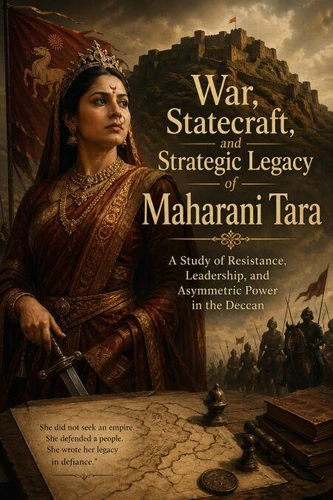
This book is an attempt to re-examine the life, leadership, and strategic environment of Maharani Tararani of the Maratha Empire through a dual lens: historical reconstruction and strategic analysis. Tararani's era was not merely a continuation of Maratha resistance following the death of Rajaram Maharaj-it was a period of sustained imperial confrontation, administrative improvisation, and asymmetric warfare against one of the most powerful empires in the Indian subcontinent.
Traditional historiography often frames her role within the narrow boundaries of succession politics or symbolic regency. This work rejects that limitation. Instead, it positions Tararani as a strategic architect of resistance systems, operating in a fragmented geopolitical landscape defined by mobility, intelligence warfare, and decentralized command structures. The aim of this book is not only to narrate events, but to extract frameworks of leadership, resilience, and statecraft that remain relevant beyond their historical context.
In doing so, this work bridges three domains: Historical scholarship Military-strategic analysis Leadership theory under crisis conditions The reader is invited to engage with Tararani not only as a historical figure, but as a case study in enduring power under existential pressure.
This book is an attempt to re-examine the life, leadership, and strategic environment of Maharani Tararani of the Maratha Empire through a dual lens: historical reconstruction and strategic analysis. Tararani's era was not merely a continuation of Maratha resistance following the death of Rajaram Maharaj-it was a period of sustained imperial confrontation, administrative improvisation, and asymmetric warfare against one of the most powerful empires in the Indian subcontinent.
Traditional historiography often frames her role within the narrow boundaries of succession politics or symbolic regency. This work rejects that limitation. Instead, it positions Tararani as a strategic architect of resistance systems, operating in a fragmented geopolitical landscape defined by mobility, intelligence warfare, and decentralized command structures. The aim of this book is not only to narrate events, but to extract frameworks of leadership, resilience, and statecraft that remain relevant beyond their historical context.
In doing so, this work bridges three domains: Historical scholarship Military-strategic analysis Leadership theory under crisis conditions The reader is invited to engage with Tararani not only as a historical figure, but as a case study in enduring power under existential pressure.


 , qui est-ce ?