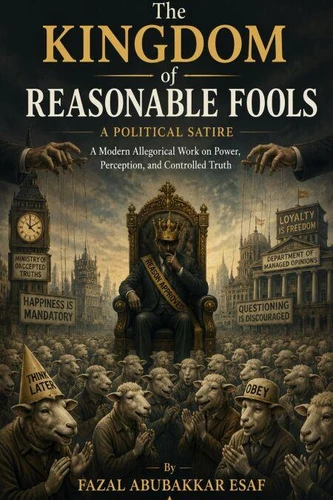
This book does not claim to describe a single nation, system, or moment in history. Instead, it reflects patterns that repeat themselves whenever power learns to speak more smoothly than truth. The Kingdom of Reasonable Fools is not built on fantasy, but on exaggeration of familiar realities. Its institutions are distorted mirrors of tendencies that appear wherever language is reshaped to serve authority, and memory is adjusted to preserve comfort.
The intent is not instruction, nor solution. It is observation-sometimes uncomfortable, sometimes absurd, often ironic. Like all satire, it relies on recognition: the reader may find fragments of known worlds scattered across unfamiliar names. If there is a moral thread, it is this: societies rarely collapse in silence or sudden chaos. More often, they drift-quietly, rationally, even politely-toward forgetting what truth once felt like.
This book does not claim to describe a single nation, system, or moment in history. Instead, it reflects patterns that repeat themselves whenever power learns to speak more smoothly than truth. The Kingdom of Reasonable Fools is not built on fantasy, but on exaggeration of familiar realities. Its institutions are distorted mirrors of tendencies that appear wherever language is reshaped to serve authority, and memory is adjusted to preserve comfort.
The intent is not instruction, nor solution. It is observation-sometimes uncomfortable, sometimes absurd, often ironic. Like all satire, it relies on recognition: the reader may find fragments of known worlds scattered across unfamiliar names. If there is a moral thread, it is this: societies rarely collapse in silence or sudden chaos. More often, they drift-quietly, rationally, even politely-toward forgetting what truth once felt like.


 , qui est-ce ?