The Sun Over Batavia
Par :Formats :
Disponible dans votre compte client Decitre ou Furet du Nord dès validation de votre commande. Le format ePub est :
- Compatible avec une lecture sur My Vivlio (smartphone, tablette, ordinateur)
- Compatible avec une lecture sur liseuses Vivlio
- Pour les liseuses autres que Vivlio, vous devez utiliser le logiciel Adobe Digital Edition. Non compatible avec la lecture sur les liseuses Kindle, Remarkable et Sony
 , qui est-ce ?
Notre partenaire de plateforme de lecture numérique où vous retrouverez l'ensemble de vos ebooks gratuitement
Pour en savoir plus sur nos ebooks, consultez notre aide en ligne ici
C'est si simple ! Lisez votre ebook avec l'app Vivlio sur votre tablette, mobile ou ordinateur :

- FormatePub
- ISBN8233535819
- EAN9798233535819
- Date de parution13/01/2026
- Protection num.pas de protection
- Infos supplémentairesepub
- ÉditeurLinda Balsamo
Résumé
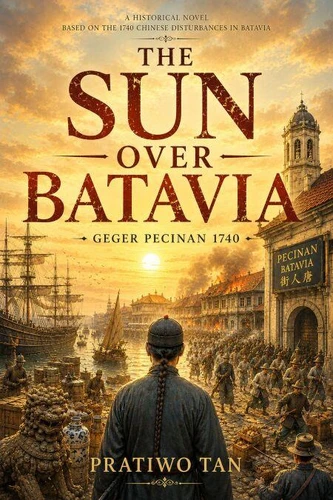
The Sun Over Batavia is not a novel that simply tells a story; it invites the reader to enter a city where history breathes, suffers, and remembers. Set in Batavia at the edge of catastrophe, the novel unfolds in a world where canals reflect more than colonial architecture-they mirror fear, longing, and lives lived under the shadow of power. Batavia is portrayed as a city of crossings: cultures, beliefs, and destinies intersect in its narrow streets.
Dutch officials govern through documents and decrees, confident in the language of order. Chinese communities survive through medicine, trade, ritual, and tightly bound human relationships. Faith moves quietly between church and temple, not as dogma, but as an ethical struggle about how to remain human when humanity itself is under threat. In this city, coexistence is fragile, always vulnerable to the moment when authority decides that some lives matter less than others.
At the heart of the novel stands Tan Sin-Ko, a Chinese physician whose life bridges healing and exile, belief and doubt, survival and sacrifice. He is not a conventional hero of conquest or rebellion, but a figure of moral endurance. Through him, the novel explores what it means to choose compassion when violence is normalized, and silence becomes a form of survival. His journey is intimate and philosophical, shaped by love delayed, faith questioned, and a longing for inner peace that the city seems determined to deny.
What makes The Sun Over Batavia compelling is its refusal to let political history speak alone. The novel challenges the clean language of archives and official reports, replacing it with the voices of those who were never asked to testify. It asks unsettling questions: Who decides which suffering is remembered? Why is stability valued more than justice? And what happens when a city builds its future on forgotten graves?Religion in the novel is not a boundary but a conversation.
Christianity and temple beliefs meet not in theological debate, but in shared moral ground-the obligation to love others, to protect life, and to resist cruelty. Faith becomes less about certainty and more about responsibility. In a world collapsing under hatred and fear, belief is tested not by prayer, but by action. Stylistically, the novel adopts a lyrical, literary tone where narration and dialogue flow seamlessly, blurring the line between thought, speech, and memory.
This creates an intimate reading experience, as if the city itself is speaking-sometimes softly, sometimes in anguish. The prose lingers on small details: the smell of herbs in a clinic, the texture of worn paper, the quiet weight of an unspoken farewell. These moments anchor the vast historical tragedy in human scale. Ultimately, The Sun Over Batavia is a novel about remembrance. It insists that cities are not defined by monuments or policies alone, but by the lives that pass through them and the wounds they carry forward.
It argues that humanity's true history is written not only in dates and decisions, but in love restrained, choices endured, and consciences awakened. For readers drawn to historical fiction that is reflective rather than triumphant, poetic rather than loud, and morally urgent without being didactic, The Sun Over Batavia offers a powerful experience. It is a novel that does not let the past rest quietly.
Instead, it asks the reader to listen-to the city, to its silenced people, and to the enduring question of how one remains human when history itself seems to forget.
Dutch officials govern through documents and decrees, confident in the language of order. Chinese communities survive through medicine, trade, ritual, and tightly bound human relationships. Faith moves quietly between church and temple, not as dogma, but as an ethical struggle about how to remain human when humanity itself is under threat. In this city, coexistence is fragile, always vulnerable to the moment when authority decides that some lives matter less than others.
At the heart of the novel stands Tan Sin-Ko, a Chinese physician whose life bridges healing and exile, belief and doubt, survival and sacrifice. He is not a conventional hero of conquest or rebellion, but a figure of moral endurance. Through him, the novel explores what it means to choose compassion when violence is normalized, and silence becomes a form of survival. His journey is intimate and philosophical, shaped by love delayed, faith questioned, and a longing for inner peace that the city seems determined to deny.
What makes The Sun Over Batavia compelling is its refusal to let political history speak alone. The novel challenges the clean language of archives and official reports, replacing it with the voices of those who were never asked to testify. It asks unsettling questions: Who decides which suffering is remembered? Why is stability valued more than justice? And what happens when a city builds its future on forgotten graves?Religion in the novel is not a boundary but a conversation.
Christianity and temple beliefs meet not in theological debate, but in shared moral ground-the obligation to love others, to protect life, and to resist cruelty. Faith becomes less about certainty and more about responsibility. In a world collapsing under hatred and fear, belief is tested not by prayer, but by action. Stylistically, the novel adopts a lyrical, literary tone where narration and dialogue flow seamlessly, blurring the line between thought, speech, and memory.
This creates an intimate reading experience, as if the city itself is speaking-sometimes softly, sometimes in anguish. The prose lingers on small details: the smell of herbs in a clinic, the texture of worn paper, the quiet weight of an unspoken farewell. These moments anchor the vast historical tragedy in human scale. Ultimately, The Sun Over Batavia is a novel about remembrance. It insists that cities are not defined by monuments or policies alone, but by the lives that pass through them and the wounds they carry forward.
It argues that humanity's true history is written not only in dates and decisions, but in love restrained, choices endured, and consciences awakened. For readers drawn to historical fiction that is reflective rather than triumphant, poetic rather than loud, and morally urgent without being didactic, The Sun Over Batavia offers a powerful experience. It is a novel that does not let the past rest quietly.
Instead, it asks the reader to listen-to the city, to its silenced people, and to the enduring question of how one remains human when history itself seems to forget.
A propos de Pratiwo Tan




4,49 €

4,49 €
4,49 €