Yogyakarta holds histories that are not always written in books. Some survive in old buildings, forgotten streets, abandoned graves, and memories that families choose never to speak about. Others remain hidden beneath the surface of the city, waiting for someone brave enough to uncover them. Lian walks once again through Malioboro, Beringharjo Market, Ketandan, and Jetis, the familiar streets that have become part of his life.
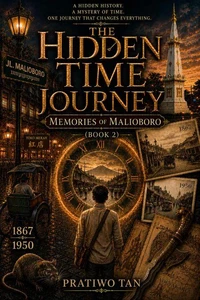
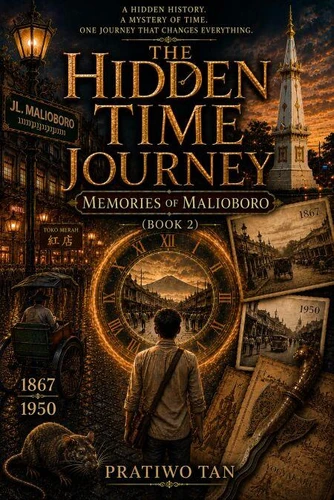
But a mysterious passage opens a doorway into the past and carries him back to Yogyakarta in 1950, when the city is still recovering from war and struggling to rebuild itself. Malioboro is different in those days. Its broad sidewalks are filled with pedicabs, horse-drawn carriages, old bicycles, vendors, students, workers, and street musicians. The city moves at a slower rhythm, closer to the people who inhabit it.
But when night falls, Yogyakarta reveals another face. Lian enters Pasar Kembang, a district known for its nightlife and prostitution. In its narrow, dimly lit alleys, ordinary families live alongside women who survive by selling their bodies. Kroncong music, guitar melodies, laughter, flirtation, and whispered conversations mingle beneath the night sky. Behind the doors are stories of loneliness, poverty, desire, survival, and love-stories rarely preserved in official histories.
Yet Pasar Kembang is more than a place of darkness. It is a hidden theatre of human life, where people who have been forgotten by history continue to struggle, dream, and love. There, Lian discovers a trail that may lead directly into the forgotten history of his own family. His search takes him farther, to Jetis, where an abandoned former opium factory has become a vast warehouse filled with Dutch books.
The books lie in heaps like forgotten graves. Some have been eaten by termites, others covered in mold, while many still preserve photographs, maps, architectural drawings, literature, and memories of a vanished colonial world. Lian calls it the Necropolis of Dutch Books. Among its forgotten volumes, he discovers records that reveal how the Dutch once imagined, organized, and represented the cities of the East Indies.
What was once knowledge has become almost unreadable, buried beneath war, political change, language, and time. Then something inexplicable begins to happen. The books seem to speak. At first, Lian hears only faint whispers among the shelves. Soon the voices become clearer, as though forgotten memories are calling to be remembered. They seem to know that he is searching for something-or someone. Yogyakarta itself begins to change before his eyes.
The city becomes a gigantic book. Every street is a page. Every market holds a story. Every cemetery preserves a memory. Every old building conceals another layer of the past. From Malioboro to Beringharjo Market, from Ketandan to Jetis, and from the Necropolis of Dutch Books to the shadowy alleys of Pasar Kembang, Lian follows a trail that crosses not only space, but time. Along the way, he encounters forgotten books, colonial memories, stories of Javanese, Chinese, and Dutch encounters, mysterious voices, ancient beliefs, and lives that history chose to leave behind.
Slowly, he realizes that the past is never truly silent. It survives in buildings, streets, books, family stories, and in the memories of those whom history has forgotten. And somewhere inside that buried past lies a secret connected to his father. A secret that could change everything Lian believes about his family. Book 2 is a journey through time and through the hidden layers of Yogyakarta-a story of Malioboro, Pasar Kembang, colonial memory, forgotten knowledge, love, mystery, and the fragile boundary between history and remembrance.
Because sometimes the greatest mystery is not what happened in the past.
Yogyakarta holds histories that are not always written in books. Some survive in old buildings, forgotten streets, abandoned graves, and memories that families choose never to speak about. Others remain hidden beneath the surface of the city, waiting for someone brave enough to uncover them. Lian walks once again through Malioboro, Beringharjo Market, Ketandan, and Jetis, the familiar streets that have become part of his life.
But a mysterious passage opens a doorway into the past and carries him back to Yogyakarta in 1950, when the city is still recovering from war and struggling to rebuild itself. Malioboro is different in those days. Its broad sidewalks are filled with pedicabs, horse-drawn carriages, old bicycles, vendors, students, workers, and street musicians. The city moves at a slower rhythm, closer to the people who inhabit it.
But when night falls, Yogyakarta reveals another face. Lian enters Pasar Kembang, a district known for its nightlife and prostitution. In its narrow, dimly lit alleys, ordinary families live alongside women who survive by selling their bodies. Kroncong music, guitar melodies, laughter, flirtation, and whispered conversations mingle beneath the night sky. Behind the doors are stories of loneliness, poverty, desire, survival, and love-stories rarely preserved in official histories.
Yet Pasar Kembang is more than a place of darkness. It is a hidden theatre of human life, where people who have been forgotten by history continue to struggle, dream, and love. There, Lian discovers a trail that may lead directly into the forgotten history of his own family. His search takes him farther, to Jetis, where an abandoned former opium factory has become a vast warehouse filled with Dutch books.
The books lie in heaps like forgotten graves. Some have been eaten by termites, others covered in mold, while many still preserve photographs, maps, architectural drawings, literature, and memories of a vanished colonial world. Lian calls it the Necropolis of Dutch Books. Among its forgotten volumes, he discovers records that reveal how the Dutch once imagined, organized, and represented the cities of the East Indies.
What was once knowledge has become almost unreadable, buried beneath war, political change, language, and time. Then something inexplicable begins to happen. The books seem to speak. At first, Lian hears only faint whispers among the shelves. Soon the voices become clearer, as though forgotten memories are calling to be remembered. They seem to know that he is searching for something-or someone. Yogyakarta itself begins to change before his eyes.
The city becomes a gigantic book. Every street is a page. Every market holds a story. Every cemetery preserves a memory. Every old building conceals another layer of the past. From Malioboro to Beringharjo Market, from Ketandan to Jetis, and from the Necropolis of Dutch Books to the shadowy alleys of Pasar Kembang, Lian follows a trail that crosses not only space, but time. Along the way, he encounters forgotten books, colonial memories, stories of Javanese, Chinese, and Dutch encounters, mysterious voices, ancient beliefs, and lives that history chose to leave behind.
Slowly, he realizes that the past is never truly silent. It survives in buildings, streets, books, family stories, and in the memories of those whom history has forgotten. And somewhere inside that buried past lies a secret connected to his father. A secret that could change everything Lian believes about his family. Book 2 is a journey through time and through the hidden layers of Yogyakarta-a story of Malioboro, Pasar Kembang, colonial memory, forgotten knowledge, love, mystery, and the fragile boundary between history and remembrance.
Because sometimes the greatest mystery is not what happened in the past.