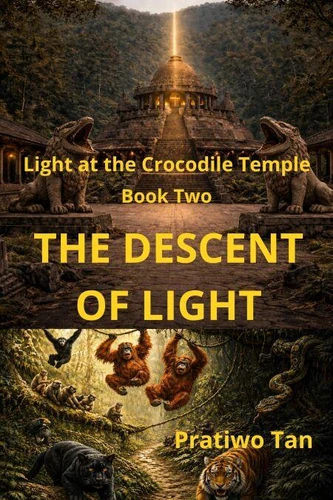
Book Two The Descent of Light. Light at the Crocodile Temple, #2
Par :Formats :
Disponible dans votre compte client Decitre ou Furet du Nord dès validation de votre commande. Le format ePub est :
- Compatible avec une lecture sur My Vivlio (smartphone, tablette, ordinateur)
- Compatible avec une lecture sur liseuses Vivlio
- Pour les liseuses autres que Vivlio, vous devez utiliser le logiciel Adobe Digital Edition. Non compatible avec la lecture sur les liseuses Kindle, Remarkable et Sony
 , qui est-ce ?
Notre partenaire de plateforme de lecture numérique où vous retrouverez l'ensemble de vos ebooks gratuitement
Pour en savoir plus sur nos ebooks, consultez notre aide en ligne ici
C'est si simple ! Lisez votre ebook avec l'app Vivlio sur votre tablette, mobile ou ordinateur :

- FormatePub
- ISBN8235099227
- EAN9798235099227
- Date de parution05/05/2026
- Protection num.pas de protection
- Infos supplémentairesepub
- ÉditeurIoakim Ioakim
Résumé
This novel tells the life journey of Karman, a young Chinese-Indonesian man from the small town of Bawangsari whose life changes drastically after the 30 September Movement in 1965. Because of his past connection with LEKRA, he is accused of being a member of the PKI, even though he was never involved in any rebellion. The accusation turns him into a fugitive. To save himself, Karman leaves behind his family, his past, and his old life, fleeing deep into the interior of Kalimantan.
His journey brings him to Nagapura, a river town sustained by floating markets and boat traffic. There, he begins a new life as a humble noodle seller. The river becomes his new living space-a place of trade, encounters, and inner healing. Through life in the floating market, Karman comes to know the Dayak people, especially through his friendship with Jata, a young Dayak man who leads him deeper into the forest, into a region filled with rivers and spiritual mystery.
Eventually, Karman arrives at Dusun Buaya and Desa Nanga Buaya. Dusun Buaya is a traditional Dayak longhouse community where families live together under strong customary ties. Desa Nanga Buaya lies in the middle of Lake Buaya, with a wooden church built on a floating platform as the spiritual center of its Christian community. Life there is deeply connected to nature: the river is the main road, the forest is both companion and guardian, and faith stands at the center of daily life.
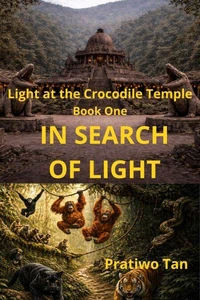
In this region stands Candi Buaya, an ancient temple hidden in dense forest. It is not merely a relic, but a spiritual center for the local people. Its architecture is filled with reliefs, statues, and a sacred chamber called the Equinox Room. This room is highly respected because, during the equinox, sunlight falls directly onto a black granite altar at the center. This is seen as a divine sign, symbolizing balance between heaven and earth, light and darkness, past and present.
Although it comes from ancient Hindu heritage, Candi Buaya has become part of Christian life in Nanga Buaya. A large cross stands in its courtyard, and celebrations such as Good Friday and Easter are often held there. Here, Christian faith, Dayak culture, and ancient history meet in a unique sacred atmosphere. The temple is also believed to hold a secret connected to an old kingdom, the legend of Gajah Mada, and treasure hidden beneath the altar.
In Nanga Buaya, Karman is welcomed by Christine, a gentle and intelligent Dayak Christian girl who plays the sape. Through her, he begins to feel the warmth of family again. Together with Pastor Heinrich, a German priest who has long served the local church, Karman slowly begins a deep spiritual journey. He learns about forgiveness, hope, and the meaning of suffering through Good Friday, Holy Saturday, and Easter worship.
Church hymns such as Amazing Grace, Were You There, and How Great Thou Art become part of his inner struggle. He wrestles with guilt, fear as a fugitive, and longing for the family he left behind. In the silence of the forest and the sound of the river at night, he begins to understand that salvation is not only escaping the past, but also accepting himself and trusting in God's love. Yet peace does not last.
A group from Jakarta arrives, claiming to be archaeologists who want to open the sacred altar in the Equinox Room for research. For the villagers, this is not just science, but a threat to the center of their faith. Behind the reason of history lies greed for the secret hidden beneath the altar. What should have been a joyful Easter becomes a struggle between faith, history, and human desire. Karman must face the greatest question of his life: is God truly present when sacred ground is touched by human greed?
His journey brings him to Nagapura, a river town sustained by floating markets and boat traffic. There, he begins a new life as a humble noodle seller. The river becomes his new living space-a place of trade, encounters, and inner healing. Through life in the floating market, Karman comes to know the Dayak people, especially through his friendship with Jata, a young Dayak man who leads him deeper into the forest, into a region filled with rivers and spiritual mystery.
Eventually, Karman arrives at Dusun Buaya and Desa Nanga Buaya. Dusun Buaya is a traditional Dayak longhouse community where families live together under strong customary ties. Desa Nanga Buaya lies in the middle of Lake Buaya, with a wooden church built on a floating platform as the spiritual center of its Christian community. Life there is deeply connected to nature: the river is the main road, the forest is both companion and guardian, and faith stands at the center of daily life.
In this region stands Candi Buaya, an ancient temple hidden in dense forest. It is not merely a relic, but a spiritual center for the local people. Its architecture is filled with reliefs, statues, and a sacred chamber called the Equinox Room. This room is highly respected because, during the equinox, sunlight falls directly onto a black granite altar at the center. This is seen as a divine sign, symbolizing balance between heaven and earth, light and darkness, past and present.
Although it comes from ancient Hindu heritage, Candi Buaya has become part of Christian life in Nanga Buaya. A large cross stands in its courtyard, and celebrations such as Good Friday and Easter are often held there. Here, Christian faith, Dayak culture, and ancient history meet in a unique sacred atmosphere. The temple is also believed to hold a secret connected to an old kingdom, the legend of Gajah Mada, and treasure hidden beneath the altar.
In Nanga Buaya, Karman is welcomed by Christine, a gentle and intelligent Dayak Christian girl who plays the sape. Through her, he begins to feel the warmth of family again. Together with Pastor Heinrich, a German priest who has long served the local church, Karman slowly begins a deep spiritual journey. He learns about forgiveness, hope, and the meaning of suffering through Good Friday, Holy Saturday, and Easter worship.
Church hymns such as Amazing Grace, Were You There, and How Great Thou Art become part of his inner struggle. He wrestles with guilt, fear as a fugitive, and longing for the family he left behind. In the silence of the forest and the sound of the river at night, he begins to understand that salvation is not only escaping the past, but also accepting himself and trusting in God's love. Yet peace does not last.
A group from Jakarta arrives, claiming to be archaeologists who want to open the sacred altar in the Equinox Room for research. For the villagers, this is not just science, but a threat to the center of their faith. Behind the reason of history lies greed for the secret hidden beneath the altar. What should have been a joyful Easter becomes a struggle between faith, history, and human desire. Karman must face the greatest question of his life: is God truly present when sacred ground is touched by human greed?