SOLDES
Jusqu'à -70% sur une sélection d'articles*

Tatung: Trance at the Festival
Par :Formats :
Disponible dans votre compte client Decitre ou Furet du Nord dès validation de votre commande. Le format ePub est :
- Compatible avec une lecture sur My Vivlio (smartphone, tablette, ordinateur)
- Compatible avec une lecture sur liseuses Vivlio
- Pour les liseuses autres que Vivlio, vous devez utiliser le logiciel Adobe Digital Edition. Non compatible avec la lecture sur les liseuses Kindle, Remarkable et Sony
 , qui est-ce ?
Notre partenaire de plateforme de lecture numérique où vous retrouverez l'ensemble de vos ebooks gratuitement
Pour en savoir plus sur nos ebooks, consultez notre aide en ligne ici
C'est si simple ! Lisez votre ebook avec l'app Vivlio sur votre tablette, mobile ou ordinateur :

- FormatePub
- ISBN8233462016
- EAN9798233462016
- Date de parution03/03/2026
- Protection num.pas de protection
- Infos supplémentairesepub
- ÉditeurLinda Balsamo
Résumé
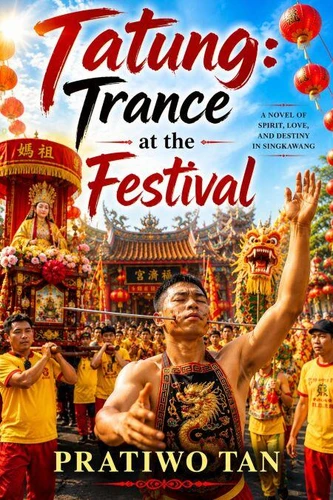
The magical field is an unseen realm where the energy of the universe whispers softly, flowing like a secret light dancing between the heavens and the human soul. Tatung: Trance at the Festival brings readers into Singkawang, a coastal town in West Kalimantan, Borneo, Indonesia, widely known as the City of a Thousand Temples. Each year, during Cap Go Meh-the fifteenth and final day of the Lunar New Year-the town transforms into one of the most remarkable spiritual celebrations in Southeast Asia.
What appears outwardly as a festival is, for the people of Singkawang, a sacred threshold where the visible and invisible worlds draw close together. At the heart of local belief lies the idea of a living magical field-an unseen spiritual equilibrium shaped by centuries of devotion, ritual movement, and ancestral memory. Temples are not merely places of worship but spiritual anchors linked through processions, incense smoke, and whispered prayers.
The rituals of Cap Go Meh are understood as acts of cosmic restoration, renewing harmony between heaven, earth, and humanity, and safeguarding the well-being of the community. Central to the celebration are the tatung, spirit mediums who enter trance and are believed to be temporarily inhabited by protective deities. In this altered state, they perform extraordinary acts-piercing their cheeks with steel rods or walking upon blades without injury-not as spectacle, but as sacred purification.
For the people of Singkawang, these rituals cleanse misfortune and shield the city from unseen harm. Dragons also hold profound spiritual significance. Through the Eye-Opening Ritual, priests invite divine energy into dragon effigies, awakening them as living vessels of cosmic power. At the festival's close, the Burning of the Dragon returns this sacred force to the heavens, completing a cycle of descent, protection, and renewal.
A luminous presence throughout the story is Kwan Im, the Goddess of Compassion, whose mercy is believed to flow quietly through human destiny. In Singkawang, devotion to Kwan Im reflects the conviction that divine compassion is not distant, but intimately woven into everyday life. The spiritual landscape of Singkawang grew from centuries of encounter between Chinese migrants, indigenous Dayak cosmology, and the wider Indonesian world.
Buddhism, Taoism, ancestral veneration, and local belief coexist in a shared cultural rhythm, where faith is communal rather than exclusive, lived rather than declared. The novel also remembers the old Chinese quarter before the great fire of 1937, when Pecinan stood with its wooden shop houses and communal tulou dwellings-fortified earthen homes that sheltered generations beneath a single roof. Within those circular walls lived stories of migration, resilience, kinship, and quiet endurance.
The memory of that vanished settlement lingers like incense smoke, reminding readers that cities, like hearts, are shaped as much by loss as by celebration. Among those memories lives the story of the Tan family, once bound together within the walls of a tulou. Like many migrant families, their lives were shaped by journeys across seas and by the currents of history that scattered relatives across distant lands.
Separation, longing, and the hope of reunion became part of their inheritance. Beyond ritual and mysticism, Tatung: Trance at the Festival is ultimately a human story-of longing, faith, separation, and love. Amid sacred ceremonies and supernatural encounters, its characters confront identity and destiny, and the haunting question of whether love must always culminate in union. In Singkawang, the gods may descend among mortals-but it is often the human heart that undergoes the deepest transformation.
What appears outwardly as a festival is, for the people of Singkawang, a sacred threshold where the visible and invisible worlds draw close together. At the heart of local belief lies the idea of a living magical field-an unseen spiritual equilibrium shaped by centuries of devotion, ritual movement, and ancestral memory. Temples are not merely places of worship but spiritual anchors linked through processions, incense smoke, and whispered prayers.
The rituals of Cap Go Meh are understood as acts of cosmic restoration, renewing harmony between heaven, earth, and humanity, and safeguarding the well-being of the community. Central to the celebration are the tatung, spirit mediums who enter trance and are believed to be temporarily inhabited by protective deities. In this altered state, they perform extraordinary acts-piercing their cheeks with steel rods or walking upon blades without injury-not as spectacle, but as sacred purification.
For the people of Singkawang, these rituals cleanse misfortune and shield the city from unseen harm. Dragons also hold profound spiritual significance. Through the Eye-Opening Ritual, priests invite divine energy into dragon effigies, awakening them as living vessels of cosmic power. At the festival's close, the Burning of the Dragon returns this sacred force to the heavens, completing a cycle of descent, protection, and renewal.
A luminous presence throughout the story is Kwan Im, the Goddess of Compassion, whose mercy is believed to flow quietly through human destiny. In Singkawang, devotion to Kwan Im reflects the conviction that divine compassion is not distant, but intimately woven into everyday life. The spiritual landscape of Singkawang grew from centuries of encounter between Chinese migrants, indigenous Dayak cosmology, and the wider Indonesian world.
Buddhism, Taoism, ancestral veneration, and local belief coexist in a shared cultural rhythm, where faith is communal rather than exclusive, lived rather than declared. The novel also remembers the old Chinese quarter before the great fire of 1937, when Pecinan stood with its wooden shop houses and communal tulou dwellings-fortified earthen homes that sheltered generations beneath a single roof. Within those circular walls lived stories of migration, resilience, kinship, and quiet endurance.
The memory of that vanished settlement lingers like incense smoke, reminding readers that cities, like hearts, are shaped as much by loss as by celebration. Among those memories lives the story of the Tan family, once bound together within the walls of a tulou. Like many migrant families, their lives were shaped by journeys across seas and by the currents of history that scattered relatives across distant lands.
Separation, longing, and the hope of reunion became part of their inheritance. Beyond ritual and mysticism, Tatung: Trance at the Festival is ultimately a human story-of longing, faith, separation, and love. Amid sacred ceremonies and supernatural encounters, its characters confront identity and destiny, and the haunting question of whether love must always culminate in union. In Singkawang, the gods may descend among mortals-but it is often the human heart that undergoes the deepest transformation.