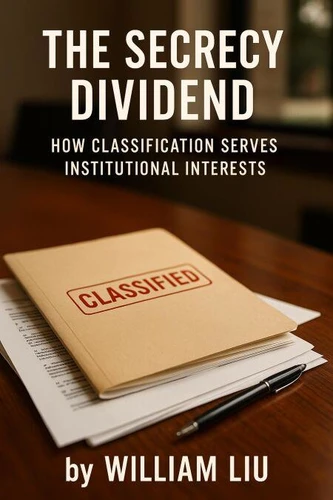
The Secrecy Dividend: How Classification Serves Institutional Interests exposes the hidden architecture of power behind modern governments, intelligence agencies, and multinational institutions. Drawing on declassified records, whistleblower testimony, and economic analysis, author William Liu reveals how secrecy has evolved from a national-security necessity into a structural advantage that shields failure, corruption, and self-preservation.
From Cold War intelligence networks to twenty-first-century surveillance capitalism, this book follows the money, the policies, and the incentives that allow unaccountable systems to thrive in the dark. It uncovers how classification protects institutions rather than citizens-and how information control shapes what societies believe to be true. Written with precision and moral clarity, The Secrecy Dividend challenges readers to see beyond official narratives and confront the question: how can democracy survive when power operates where democracy cannot see?
The Secrecy Dividend: How Classification Serves Institutional Interests exposes the hidden architecture of power behind modern governments, intelligence agencies, and multinational institutions. Drawing on declassified records, whistleblower testimony, and economic analysis, author William Liu reveals how secrecy has evolved from a national-security necessity into a structural advantage that shields failure, corruption, and self-preservation.
From Cold War intelligence networks to twenty-first-century surveillance capitalism, this book follows the money, the policies, and the incentives that allow unaccountable systems to thrive in the dark. It uncovers how classification protects institutions rather than citizens-and how information control shapes what societies believe to be true. Written with precision and moral clarity, The Secrecy Dividend challenges readers to see beyond official narratives and confront the question: how can democracy survive when power operates where democracy cannot see?


 , qui est-ce ?