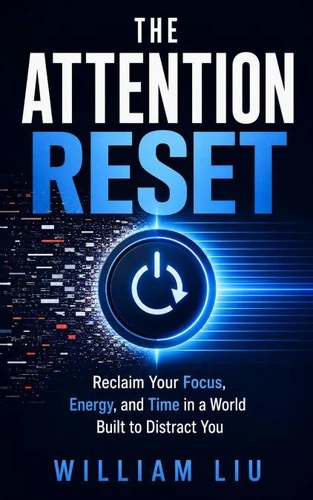
Your attention is not broken. It is being competed for. Every notification, message, headline, open tab, social feed, and unfinished task makes a claim on your attention. Add work pressure, poor sleep, stress, constant communication, and devices designed around endless novelty, and staying focused can begin to feel almost impossible. The Attention Reset offers a practical way to take back control without abandoning technology, deleting your entire digital life, or turning productivity into another obsession.
William Liu shows why distraction is not simply a failure of discipline. Attention is shaped by your environment, energy, task design, digital cues, emotional state, social expectations, and the friction built into everyday choices. Inside, you'll learn how to: Reduce interruptions without becoming unreachable Make important work easier to start Stop relying on willpower alone Understand the hidden cost of task switching Break notification and checking habits Use phones and social media more deliberately Protect focused work while still handling real responsibilities Design email, meetings, and communication around attention Match demanding work to your actual energy Recover after interruptions instead of losing the rest of the day Protect relationships from constant partial attention Build an environment where priorities have a better chance to win Use a practical 30-day reset when your system has drifted The method rests on five principles: clarity beats intensity, friction is more dependable than self-control, attention follows energy, environment shapes decisions, and the purpose of focus is not productivity for its own sake-it is having more attention available for the parts of life that matter.
This is not a book about becoming perfectly focused. Distraction will still happen. Bad weeks will still happen. New apps, deadlines, travel, stress, and changing responsibilities will disrupt even good systems. The goal is learning how to return. The book includes practical resets for phones, reactive days, travel, conversations, evening routines, deadlines, poor-sleep days, and other real-world situations.
And unlike systems built around perfect streaks, The Attention Reset treats drift as normal. When life changes, you make a small correction and continue. You do not need to optimize every minute. You need enough control over your attention that your days reflect your priorities-not simply whatever signal happens to be loudest.
Your attention is not broken. It is being competed for. Every notification, message, headline, open tab, social feed, and unfinished task makes a claim on your attention. Add work pressure, poor sleep, stress, constant communication, and devices designed around endless novelty, and staying focused can begin to feel almost impossible. The Attention Reset offers a practical way to take back control without abandoning technology, deleting your entire digital life, or turning productivity into another obsession.
William Liu shows why distraction is not simply a failure of discipline. Attention is shaped by your environment, energy, task design, digital cues, emotional state, social expectations, and the friction built into everyday choices. Inside, you'll learn how to: Reduce interruptions without becoming unreachable Make important work easier to start Stop relying on willpower alone Understand the hidden cost of task switching Break notification and checking habits Use phones and social media more deliberately Protect focused work while still handling real responsibilities Design email, meetings, and communication around attention Match demanding work to your actual energy Recover after interruptions instead of losing the rest of the day Protect relationships from constant partial attention Build an environment where priorities have a better chance to win Use a practical 30-day reset when your system has drifted The method rests on five principles: clarity beats intensity, friction is more dependable than self-control, attention follows energy, environment shapes decisions, and the purpose of focus is not productivity for its own sake-it is having more attention available for the parts of life that matter.
This is not a book about becoming perfectly focused. Distraction will still happen. Bad weeks will still happen. New apps, deadlines, travel, stress, and changing responsibilities will disrupt even good systems. The goal is learning how to return. The book includes practical resets for phones, reactive days, travel, conversations, evening routines, deadlines, poor-sleep days, and other real-world situations.
And unlike systems built around perfect streaks, The Attention Reset treats drift as normal. When life changes, you make a small correction and continue. You do not need to optimize every minute. You need enough control over your attention that your days reflect your priorities-not simply whatever signal happens to be loudest.


 , qui est-ce ?