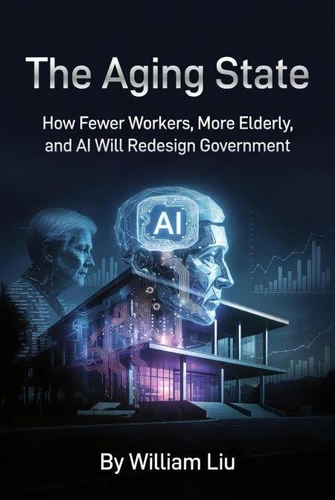
The Aging State : How Fewer Workers, More Elderly, and AI Will Redesign Government
Par :Formats :
Disponible dans votre compte client Decitre ou Furet du Nord dès validation de votre commande. Le format ePub est :
- Compatible avec une lecture sur My Vivlio (smartphone, tablette, ordinateur)
- Compatible avec une lecture sur liseuses Vivlio
- Pour les liseuses autres que Vivlio, vous devez utiliser le logiciel Adobe Digital Edition. Non compatible avec la lecture sur les liseuses Kindle, Remarkable et Sony
 , qui est-ce ?
Notre partenaire de plateforme de lecture numérique où vous retrouverez l'ensemble de vos ebooks gratuitement
Pour en savoir plus sur nos ebooks, consultez notre aide en ligne ici
C'est si simple ! Lisez votre ebook avec l'app Vivlio sur votre tablette, mobile ou ordinateur :

- FormatePub
- ISBN8233052323
- EAN9798233052323
- Date de parution23/01/2026
- Protection num.pas de protection
- Infos supplémentairesepub
- ÉditeurLinda Balsamo
Résumé
Modern governments were designed for a world that no longer exists. They assumed growing populations, expanding workforces, and short retirements. Those assumptions are now breaking everywhere at once. Across developed societies, birth rates have collapsed, populations are aging rapidly, and the ratio of workers to dependents is shrinking beyond what welfare states were built to sustain. Pension systems strain, healthcare costs surge, and public administrations face staffing shortages just as demand for services accelerates.
Traditional policy tools no longer scale. Raising taxes, cutting benefits, or extending retirement ages only delays the underlying reckoning. The Aging State examines how governments respond when demographic growth is no longer available as a solution. It shows how artificial intelligence and automation become structural necessities rather than optional upgrades, quietly replacing human administrators in welfare systems, healthcare management, taxation, compliance, and public decision-making.
This shift is not driven by ideology or innovation alone, but by demographic math that leaves states with no alternative. Drawing on demographic trends, economic constraints, and emerging governance practices, this book explains how the nature of government itself is changing. Authority becomes more algorithmic, administration more automated, and the relationship between citizens and the state increasingly mediated by systems rather than people.
The Aging State is a clear-eyed analysis of how governance adapts under demographic pressure. Written for readers who want to understand where public power is actually heading, it reveals how aging societies are redesigning the state to survive in a world with fewer workers, more elderly citizens, and rising dependence on artificial intelligence.
Traditional policy tools no longer scale. Raising taxes, cutting benefits, or extending retirement ages only delays the underlying reckoning. The Aging State examines how governments respond when demographic growth is no longer available as a solution. It shows how artificial intelligence and automation become structural necessities rather than optional upgrades, quietly replacing human administrators in welfare systems, healthcare management, taxation, compliance, and public decision-making.
This shift is not driven by ideology or innovation alone, but by demographic math that leaves states with no alternative. Drawing on demographic trends, economic constraints, and emerging governance practices, this book explains how the nature of government itself is changing. Authority becomes more algorithmic, administration more automated, and the relationship between citizens and the state increasingly mediated by systems rather than people.
The Aging State is a clear-eyed analysis of how governance adapts under demographic pressure. Written for readers who want to understand where public power is actually heading, it reveals how aging societies are redesigning the state to survive in a world with fewer workers, more elderly citizens, and rising dependence on artificial intelligence.