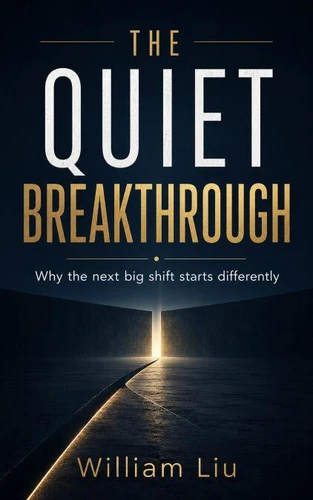
What if the biggest opportunities are already real long before the world agrees they matter?In The Quiet Breakthrough, William Liu explores the hidden period between the moment a change begins and the moment everyone finally notices it. He calls this gap the legibility lag-the window when new technologies, business models, career opportunities, and market shifts are already taking shape but have not yet received institutional approval, media attention, or widespread recognition.
Through examples drawn from business, technology, skilled trades, organizations, and everyday decision-making, Liu shows why people closest to emerging reality often see important changes first-and why so many still hesitate to act. The problem is not always a lack of information. Often, it is the permission reflex: the instinct to wait for experts, employers, competitors, credentials, or the crowd to confirm what direct experience has already revealed.
This book examines how early advantages form, why organizations routinely miss signals visible to individuals, how opportunity disappears once a trend becomes obvious, and why preparation before confirmation can matter more than prediction. The Quiet Breakthrough is not a call for reckless risk-taking or blind intuition. It is a framework for distinguishing repeated, real-world evidence from speculation-and for recognizing when waiting for more confirmation no longer reduces uncertainty but simply makes you late.
If you have ever watched an "overnight success" and wondered what happened before everyone noticed, this book takes you inside the invisible runway where the real breakthrough began.
What if the biggest opportunities are already real long before the world agrees they matter?In The Quiet Breakthrough, William Liu explores the hidden period between the moment a change begins and the moment everyone finally notices it. He calls this gap the legibility lag-the window when new technologies, business models, career opportunities, and market shifts are already taking shape but have not yet received institutional approval, media attention, or widespread recognition.
Through examples drawn from business, technology, skilled trades, organizations, and everyday decision-making, Liu shows why people closest to emerging reality often see important changes first-and why so many still hesitate to act. The problem is not always a lack of information. Often, it is the permission reflex: the instinct to wait for experts, employers, competitors, credentials, or the crowd to confirm what direct experience has already revealed.
This book examines how early advantages form, why organizations routinely miss signals visible to individuals, how opportunity disappears once a trend becomes obvious, and why preparation before confirmation can matter more than prediction. The Quiet Breakthrough is not a call for reckless risk-taking or blind intuition. It is a framework for distinguishing repeated, real-world evidence from speculation-and for recognizing when waiting for more confirmation no longer reduces uncertainty but simply makes you late.
If you have ever watched an "overnight success" and wondered what happened before everyone noticed, this book takes you inside the invisible runway where the real breakthrough began.


 , qui est-ce ?