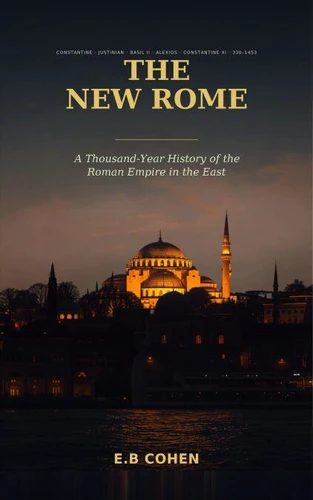
The Roman Empire did not end in 476. In the East it stood for another thousand years, ruled from a fortified city on the Bosphorus that Constantine had founded on 11 May 330 and called Nova Roma. Its people called themselves Romans, spoke Greek, held to Christianity, and outlasted the Western empire that fell around them by nearly a millennium. In The New Rome, E. B Cohen tells the whole story - from Constantine's dedication of the city, through the age of Justinian and Theodora and the raising of Hagia Sophia, past the Arab storm that took Egypt and Syria and the sieges of Constantinople that held Islam back from Europe, into the icon wars, the Macedonian renaissance under Basil II, the missions to the Slavs that gave the world the Cyrillic alphabet, the Great Schism of 1054, and the arrival of the Crusaders.
And then, at the end, the long twilight: the disaster of the Fourth Crusade in 1204, the recovery at Nicaea, the shrinking Palaiologan state, and the last day of 29 May 1453, when Constantine XI died on his walls and Mehmed II rode into the city. Sweeping and human, grounded in the latest scholarship and honest about what we know and what we only guess, this is the empire told as narrative history - the machinery of a Christian state, the engineering of Hagia Sophia, the mystery of Greek fire, the Justinianic law code that still undergirds the civil law of half the world, the coin that held its value for seven hundred years, the empresses who ruled from the palace, the scholars who kept the Greek classics alive, and the city that anchored medieval commerce and imagination.
It is also a book about how much of what you have been told is wrong: the empire was not decadent, or effete, or 'byzantine' in any of the pejorative senses the word has since acquired; 476 was not the fall of Rome; the schism of 1054 did not feel like a schism at the time; and the sack of 1204 by Christian Crusaders was worse than the Ottoman conquest of 1453. Rigorous, vivid, and complete - the story of the empire that carried Rome for another thousand years, and the world it made.
The Roman Empire did not end in 476. In the East it stood for another thousand years, ruled from a fortified city on the Bosphorus that Constantine had founded on 11 May 330 and called Nova Roma. Its people called themselves Romans, spoke Greek, held to Christianity, and outlasted the Western empire that fell around them by nearly a millennium. In The New Rome, E. B Cohen tells the whole story - from Constantine's dedication of the city, through the age of Justinian and Theodora and the raising of Hagia Sophia, past the Arab storm that took Egypt and Syria and the sieges of Constantinople that held Islam back from Europe, into the icon wars, the Macedonian renaissance under Basil II, the missions to the Slavs that gave the world the Cyrillic alphabet, the Great Schism of 1054, and the arrival of the Crusaders.
And then, at the end, the long twilight: the disaster of the Fourth Crusade in 1204, the recovery at Nicaea, the shrinking Palaiologan state, and the last day of 29 May 1453, when Constantine XI died on his walls and Mehmed II rode into the city. Sweeping and human, grounded in the latest scholarship and honest about what we know and what we only guess, this is the empire told as narrative history - the machinery of a Christian state, the engineering of Hagia Sophia, the mystery of Greek fire, the Justinianic law code that still undergirds the civil law of half the world, the coin that held its value for seven hundred years, the empresses who ruled from the palace, the scholars who kept the Greek classics alive, and the city that anchored medieval commerce and imagination.
It is also a book about how much of what you have been told is wrong: the empire was not decadent, or effete, or 'byzantine' in any of the pejorative senses the word has since acquired; 476 was not the fall of Rome; the schism of 1054 did not feel like a schism at the time; and the sack of 1204 by Christian Crusaders was worse than the Ottoman conquest of 1453. Rigorous, vivid, and complete - the story of the empire that carried Rome for another thousand years, and the world it made.


 , qui est-ce ?