
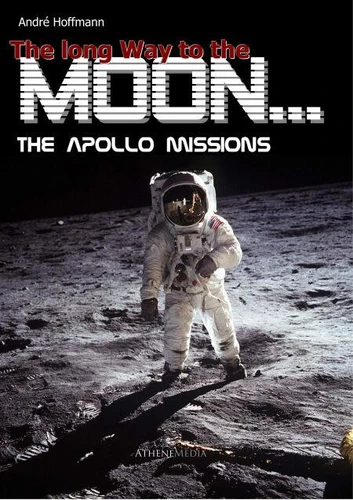
The long Way to the Moon. The Apollo Missions
Par :Formats :
Disponible dans votre compte client Decitre ou Furet du Nord dès validation de votre commande. Le format ePub est :
- Compatible avec une lecture sur My Vivlio (smartphone, tablette, ordinateur)
- Compatible avec une lecture sur liseuses Vivlio
- Pour les liseuses autres que Vivlio, vous devez utiliser le logiciel Adobe Digital Edition. Non compatible avec la lecture sur les liseuses Kindle, Remarkable et Sony
 , qui est-ce ?
Notre partenaire de plateforme de lecture numérique où vous retrouverez l'ensemble de vos ebooks gratuitement
Pour en savoir plus sur nos ebooks, consultez notre aide en ligne ici
C'est si simple ! Lisez votre ebook avec l'app Vivlio sur votre tablette, mobile ou ordinateur :

- Nombre de pages200
- FormatePub
- ISBN978-3-86992-012-2
- EAN9783869920122
- Date de parution03/10/2014
- Protection num.Digital Watermarking
- Taille20 Mo
- Infos supplémentairesepub
- ÉditeurAtheneMedia-Verlag
Résumé
It was February 1966. A Saturn V rocket began a suborbital unmanned test flight with the Apollo Command Module for the first time.
A Saturn Orbital test flight followed, without the Apollo Spaceship, in July 1966; a further flight with the Apollo Command Module took off in August 1966.
The Saturn Rocket Vehicle was developed by the scientists and technicians of the Marshall Space Flight Center (MSFC) under the direction of Dr.
Wernher von Braun for the NASA in the context of the Apollo program. This rocket type is one of the most efficient systems ever built. Research of rocket systems reaches back far to the beginning of the nineteen fifties. Long was the way till the first man could step on the moon. The Apollo program suffered a large setback when three astronauts, Virgil Grissom, Edward H. White and Roger B.
Chaffee, were killed by flames during a routine training exercise in their command module. Extensive modifications of the command module and the safety systems were the consequence of this catastrophe. This test on January 27, 1967, retroactively received the name Apollo 1. Six years after John F. Kennedy had announced the race to the moon, these were the beginnings of the Apollo program, and this was the prelude to the great finale of the way to the moon. This book shows the story of this journey.
Wernher von Braun for the NASA in the context of the Apollo program. This rocket type is one of the most efficient systems ever built. Research of rocket systems reaches back far to the beginning of the nineteen fifties. Long was the way till the first man could step on the moon. The Apollo program suffered a large setback when three astronauts, Virgil Grissom, Edward H. White and Roger B.
Chaffee, were killed by flames during a routine training exercise in their command module. Extensive modifications of the command module and the safety systems were the consequence of this catastrophe. This test on January 27, 1967, retroactively received the name Apollo 1. Six years after John F. Kennedy had announced the race to the moon, these were the beginnings of the Apollo program, and this was the prelude to the great finale of the way to the moon. This book shows the story of this journey.
A propos de André Hoffmann


1,49 €

1,49 €

Die Leute von Seldwyla
E-book
1,99 €


Clavigo. Ein Trauerspiel
E-book
1,99 €

Der Nachsommer
E-book
1,99 €

1,99 €

1,99 €

1,49 €

1,99 €

Traumnovelle
E-book
1,99 €

Einbahnstraße
E-book
1,49 €

1,99 €

1,99 €


Dichtungen
E-book
1,99 €

Die Hochzeit des Mönchs
E-book
1,49 €

1,99 €

Angela Borgia
E-book
1,49 €