She is at the crossroads. Not as a position she has arrived at. As the condition of her existence. She is the between - the threshold, the space where the categories end and the choosing begins, where the night becomes the morning and the living become the dead and the person who cannot move in any direction stands at the place where three roads meet and needs something they cannot name. She is older than Zeus.
She was at the crossroads when the world was still the undifferentiated primordial, when the categories that the Olympian order would eventually impose on reality had not yet been imposed. She was the between when everything was the between. When Zeus reorganised the divine world, he kept her privileges - not as a gift, as a recognition. You cannot reorganise the threshold. You can only acknowledge it.
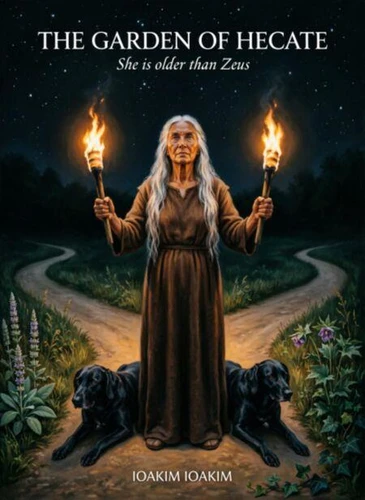
THE GARDEN OF HECATE is the literary account of the oldest and strangest figure in the Greek divine world, told from inside what she is. The garden that grows at the margin between the cultivated and the wild, between medicine and poison, between what is sanctioned and what is needed. The crossroads work - the torch held steady over three roads that all go somewhere she will not tell you, because the telling is not the work, the illuminating is the work, the choice is yours.
The dark phase of the moon when she is most completely herself. The women who come in the moonless night because they need what grows at the margin and the official channels have nothing for them. The dogs who smell what the torch cannot reach. The night Persephone crossed the threshold that Hecate governs and what it meant to witness the first time. The most experimental book in the series. The voice that has been waiting the longest.
The between that has always been there and will always be there, with the torch, at the crossroads, after the current world is done. She would not give this work to anyone.
She is at the crossroads. Not as a position she has arrived at. As the condition of her existence. She is the between - the threshold, the space where the categories end and the choosing begins, where the night becomes the morning and the living become the dead and the person who cannot move in any direction stands at the place where three roads meet and needs something they cannot name. She is older than Zeus.
She was at the crossroads when the world was still the undifferentiated primordial, when the categories that the Olympian order would eventually impose on reality had not yet been imposed. She was the between when everything was the between. When Zeus reorganised the divine world, he kept her privileges - not as a gift, as a recognition. You cannot reorganise the threshold. You can only acknowledge it.
THE GARDEN OF HECATE is the literary account of the oldest and strangest figure in the Greek divine world, told from inside what she is. The garden that grows at the margin between the cultivated and the wild, between medicine and poison, between what is sanctioned and what is needed. The crossroads work - the torch held steady over three roads that all go somewhere she will not tell you, because the telling is not the work, the illuminating is the work, the choice is yours.
The dark phase of the moon when she is most completely herself. The women who come in the moonless night because they need what grows at the margin and the official channels have nothing for them. The dogs who smell what the torch cannot reach. The night Persephone crossed the threshold that Hecate governs and what it meant to witness the first time. The most experimental book in the series. The voice that has been waiting the longest.
The between that has always been there and will always be there, with the torch, at the crossroads, after the current world is done. She would not give this work to anyone.

 , qui est-ce ?