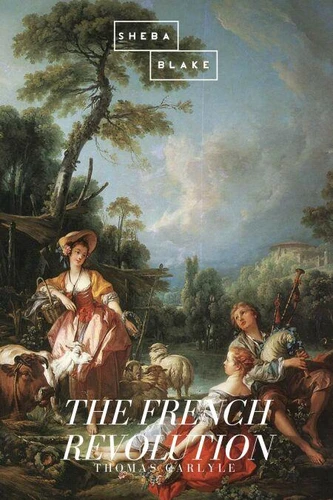
The French Revolution
Par :Formats :
Disponible dans votre compte client Decitre ou Furet du Nord dès validation de votre commande. Le format ePub est :
- Compatible avec une lecture sur My Vivlio (smartphone, tablette, ordinateur)
- Compatible avec une lecture sur liseuses Vivlio
- Pour les liseuses autres que Vivlio, vous devez utiliser le logiciel Adobe Digital Edition. Non compatible avec la lecture sur les liseuses Kindle, Remarkable et Sony
 , qui est-ce ?
Notre partenaire de plateforme de lecture numérique où vous retrouverez l'ensemble de vos ebooks gratuitement
Pour en savoir plus sur nos ebooks, consultez notre aide en ligne ici
C'est si simple ! Lisez votre ebook avec l'app Vivlio sur votre tablette, mobile ou ordinateur :

- Nombre de pages532
- FormatePub
- ISBN978-3-96189-759-9
- EAN9783961897599
- Date de parution15/05/2017
- Protection num.Digital Watermarking
- Taille965 Ko
- Infos supplémentairesepub
- ÉditeurChiemsee Verlag
Résumé
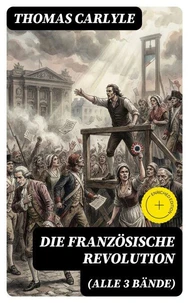
The French Revolution was written by the Scottish essayist, philosopher, and historian Thomas Carlyle. The three-volume work, first published in 1837 (with a revised edition in print by 1857), charts the course of the French Revolution from 1789 to the height of the Reign of Terror (1793-94) and culminates in 1795. A massive undertaking which draws together a wide variety of sources, Carlyle's history-despite the unusual style in which it is written-is considered to be an authoritative account of the early course of the Revolution.
John Stuart Mill, a friend of Carlyle's, found himself caught up in other projects and unable to meet the terms of a contract he had signed with his publisher for a history of the French Revolution. Mill proposed that Carlyle produce the work instead; Mill even sent his friend a library of books and other materials concerning the Revolution, and by 1834 Carlyle was working furiously on the project.
When he had completed the first volume, Carlyle sent his only complete manuscript to Mill. While in Mill's care the manuscript was destroyed, according to Mill by a careless household maid who mistook it for trash and used it as a firelighter. Carlyle then rewrote the entire manuscript, achieving what he described as a book that came "direct and flamingly from the heart." The book immediately established Carlyle's reputation as an important 19th century intellectual.
It also served as a major influence on a number of his contemporaries, most notably, perhaps, Charles Dickens, who compulsively read and re-read the book while producing A Tale of Two Cities. The book was closely studied by Mark Twain during the last year of his life, and it was reported to be the last book he read before his death.
John Stuart Mill, a friend of Carlyle's, found himself caught up in other projects and unable to meet the terms of a contract he had signed with his publisher for a history of the French Revolution. Mill proposed that Carlyle produce the work instead; Mill even sent his friend a library of books and other materials concerning the Revolution, and by 1834 Carlyle was working furiously on the project.
When he had completed the first volume, Carlyle sent his only complete manuscript to Mill. While in Mill's care the manuscript was destroyed, according to Mill by a careless household maid who mistook it for trash and used it as a firelighter. Carlyle then rewrote the entire manuscript, achieving what he described as a book that came "direct and flamingly from the heart." The book immediately established Carlyle's reputation as an important 19th century intellectual.
It also served as a major influence on a number of his contemporaries, most notably, perhaps, Charles Dickens, who compulsively read and re-read the book while producing A Tale of Two Cities. The book was closely studied by Mark Twain during the last year of his life, and it was reported to be the last book he read before his death.
A propos de Thomas Carlyle

0,99 €
1,99 €