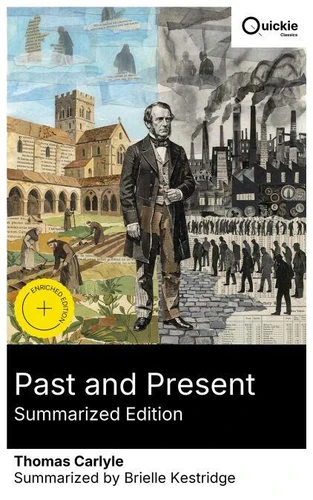
Past and Present (1843) juxtaposes Jocelin of Brakelond's chronicle of Abbot Samson at St Edmundsbury with the factories and poorhouses of industrial Britain. This genre-bending history-sermon indicts laissez-faire 'Cash Nexus' and Benthamite enumeration, railing at idle aristocracy while urging morally answerable 'Captains of Industry.' In Biblical cadences and satiric apostrophes, Carlyle uses medieval exemplum to probe the Condition-of-England question-labour, authority, and the spiritual poverty of a quantified age.
Thomas Carlyle (1795-1881), a Scottish moralist steeped in Calvinist rigor and German idealism, turned from mathematics to letters to contest utilitarian orthodoxy. After Sartor Resartus and On Heroes, he crystallized a creed of duty and leadership. Reading medieval sources amid Chartist unrest and the 1842 strikes, he sought in monastic discipline a 'usable past'-elevating work as sacred and authority as service rather than mere property.
Recommended to readers of Victorian studies, political theory, and management ethics, Past and Present remains a bracing corrective to complacent economics. Approach it for its thunderous prose and moral imagination-and for provocations that still press us to imagine institutions where labor, leadership, and justice cohere.
Quickie Classics summarizes timeless works with precision, preserving the author's voice and keeping the prose clear, fast, and readable-distilled, never diluted.
Enriched Edition extras: Introduction · Synopsis · Historical Context · Author Biography · Brief Analysis · 4 Reflection Q&As · Editorial Footnotes.
Past and Present (1843) juxtaposes Jocelin of Brakelond's chronicle of Abbot Samson at St Edmundsbury with the factories and poorhouses of industrial Britain. This genre-bending history-sermon indicts laissez-faire 'Cash Nexus' and Benthamite enumeration, railing at idle aristocracy while urging morally answerable 'Captains of Industry.' In Biblical cadences and satiric apostrophes, Carlyle uses medieval exemplum to probe the Condition-of-England question-labour, authority, and the spiritual poverty of a quantified age.
Thomas Carlyle (1795-1881), a Scottish moralist steeped in Calvinist rigor and German idealism, turned from mathematics to letters to contest utilitarian orthodoxy. After Sartor Resartus and On Heroes, he crystallized a creed of duty and leadership. Reading medieval sources amid Chartist unrest and the 1842 strikes, he sought in monastic discipline a 'usable past'-elevating work as sacred and authority as service rather than mere property.
Recommended to readers of Victorian studies, political theory, and management ethics, Past and Present remains a bracing corrective to complacent economics. Approach it for its thunderous prose and moral imagination-and for provocations that still press us to imagine institutions where labor, leadership, and justice cohere.
Quickie Classics summarizes timeless works with precision, preserving the author's voice and keeping the prose clear, fast, and readable-distilled, never diluted.
Enriched Edition extras: Introduction · Synopsis · Historical Context · Author Biography · Brief Analysis · 4 Reflection Q&As · Editorial Footnotes.

 , qui est-ce ?