
Nguy?n Dông Hung (bác si) / Nguyen Dong Hung, M. D. Bút danh / Pen name: Minh HungSinh / Born: Vi?t Nam / Vietnam
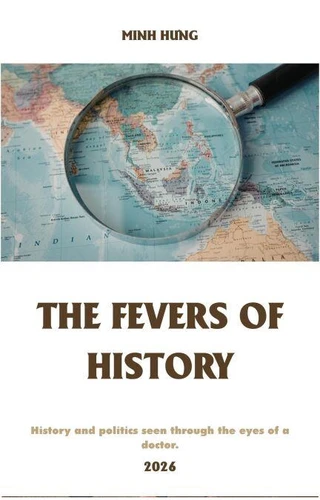
The Fevers of History
Par :Formats :
Disponible dans votre compte client Decitre ou Furet du Nord dès validation de votre commande. Le format ePub est :
- Compatible avec une lecture sur My Vivlio (smartphone, tablette, ordinateur)
- Compatible avec une lecture sur liseuses Vivlio
- Pour les liseuses autres que Vivlio, vous devez utiliser le logiciel Adobe Digital Edition. Non compatible avec la lecture sur les liseuses Kindle, Remarkable et Sony
 , qui est-ce ?
Notre partenaire de plateforme de lecture numérique où vous retrouverez l'ensemble de vos ebooks gratuitement
Pour en savoir plus sur nos ebooks, consultez notre aide en ligne ici
C'est si simple ! Lisez votre ebook avec l'app Vivlio sur votre tablette, mobile ou ordinateur :

- FormatePub
- ISBN8195588380
- EAN9798195588380
- Date de parution04/05/2026
- Protection num.pas de protection
- Infos supplémentairesepub
- ÉditeurMINH HUNG
Résumé
The Fevers of History is a distinctive work of historical and political nonfiction that reads the past through the eyes of a physician. Instead of treating history as a dry chronology of kings, wars, empires, and revolutions, Minh Hung / Nguyen Dong Hung approaches civilizations as living political bodies: with symptoms, vital signs, medical histories, immune responses, crises, recoveries, and scars.
From Hammurabi's law code and the political theater of ancient Babylon to Athens and the fever of democracy, from the fall of the Roman Republic to the centralizing power of Qin China, from Sima Qian's wounded memory to Dai Viet's struggle for legitimacy, from Machiavelli and raison d'État to the French Revolution, Lenin, Stalin, Hitler, Mao, Gandhi, Mandela, Vietnam's D?i M?i reforms, and the modern political fevers of the United States, China, and Vietnam, this book offers a sweeping yet deeply human interpretation of history.
Each chapter is structured like a "historical medical record." The patient may be a city-state, an empire, a dynasty, a republic, a revolutionary movement, or a modern nation-state. The symptoms may appear as debt, famine, war, political violence, loss of legitimacy, ideological fever, social fragmentation, or the silencing of intellectuals. The diagnosis is never simplistic: centralization may bring efficiency but reduce feedback; reform may be necessary but administered at the wrong dose; revolution may liberate but also devour itself; development may reduce poverty while producing loneliness, inequality, and distrust.
Written in a literary yet evidence-conscious style, The Fevers of History combines storytelling, political analysis, historical interpretation, and medical metaphor. It asks urgent questions: What gives power its backbone? Why do republics collapse when procedures lose credibility? Why do empires sometimes die from political autoimmunity? What role do intellectuals play in the immune system of society? How can public memory help a nation recover without imprisoning it in the past? And how can history help human beings lower the political fevers of the future?This book is for readers who love history, political thought, world civilizations, and Vietnam's place in global historical reflection.
It is also for anyone who believes that the past does not offer a magic cure, but can teach us how to recognize the symptoms of power before the fever becomes delirium.
From Hammurabi's law code and the political theater of ancient Babylon to Athens and the fever of democracy, from the fall of the Roman Republic to the centralizing power of Qin China, from Sima Qian's wounded memory to Dai Viet's struggle for legitimacy, from Machiavelli and raison d'État to the French Revolution, Lenin, Stalin, Hitler, Mao, Gandhi, Mandela, Vietnam's D?i M?i reforms, and the modern political fevers of the United States, China, and Vietnam, this book offers a sweeping yet deeply human interpretation of history.
Each chapter is structured like a "historical medical record." The patient may be a city-state, an empire, a dynasty, a republic, a revolutionary movement, or a modern nation-state. The symptoms may appear as debt, famine, war, political violence, loss of legitimacy, ideological fever, social fragmentation, or the silencing of intellectuals. The diagnosis is never simplistic: centralization may bring efficiency but reduce feedback; reform may be necessary but administered at the wrong dose; revolution may liberate but also devour itself; development may reduce poverty while producing loneliness, inequality, and distrust.
Written in a literary yet evidence-conscious style, The Fevers of History combines storytelling, political analysis, historical interpretation, and medical metaphor. It asks urgent questions: What gives power its backbone? Why do republics collapse when procedures lose credibility? Why do empires sometimes die from political autoimmunity? What role do intellectuals play in the immune system of society? How can public memory help a nation recover without imprisoning it in the past? And how can history help human beings lower the political fevers of the future?This book is for readers who love history, political thought, world civilizations, and Vietnam's place in global historical reflection.
It is also for anyone who believes that the past does not offer a magic cure, but can teach us how to recognize the symptoms of power before the fever becomes delirium.
A propos de MINH HUNG
The Apology
E-book
9,49 €
1,99 €

Urological Emergency
E-book
2,99 €

General Urology
E-book
4,49 €
Human to Human
E-book
2,99 €

Jewish History
E-book
2,99 €
Gold-Plated Puppets
E-book
4,49 €
Boredrom and Creativity
E-book
4,49 €
Behind a Patient
E-book
4,49 €
The Awakened Physician
E-book
2,99 €

11,49 €
7,99 €

4,49 €

Strange History
E-book
4,49 €

Human Lives in the City
E-book
2,99 €

Philosophy of Life
E-book
4,49 €
4,49 €
Men Talking to Men
E-book
6,99 €

6,99 €