
Nguy?n Dông Hung (bác si) / Nguyen Dong Hung, M. D. Bút danh / Pen name: Minh HungSinh / Born: Vi?t Nam / Vietnam
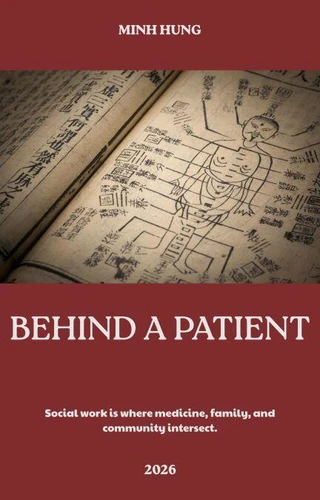
Behind a Patient
Par :Formats :
Disponible dans votre compte client Decitre ou Furet du Nord dès validation de votre commande. Le format ePub est :
- Compatible avec une lecture sur My Vivlio (smartphone, tablette, ordinateur)
- Compatible avec une lecture sur liseuses Vivlio
- Pour les liseuses autres que Vivlio, vous devez utiliser le logiciel Adobe Digital Edition. Non compatible avec la lecture sur les liseuses Kindle, Remarkable et Sony
 , qui est-ce ?
Notre partenaire de plateforme de lecture numérique où vous retrouverez l'ensemble de vos ebooks gratuitement
Pour en savoir plus sur nos ebooks, consultez notre aide en ligne ici
C'est si simple ! Lisez votre ebook avec l'app Vivlio sur votre tablette, mobile ou ordinateur :

- FormatePub
- ISBN8198005501
- EAN9798198005501
- Date de parution21/05/2026
- Protection num.pas de protection
- Infos supplémentairesepub
- ÉditeurMINH HUNG
Résumé
Behind a Patient: Social Work at the Intersection of Medicine, Family, and Community is a work on medical social work in the context of contemporary Vietnam. The book begins with a fundamental question: why, amid increasingly advanced medicine, do many patients still leave the clinic without truly being seen as whole human beings?Minh Hung / Nguy?n Dông Hung approaches patients not only through symptoms, tests, prescriptions, or hospital fees, but through the entire life behind illness: family, work, income, housing, caregivers, fear, belief, loneliness, and the risk of being left behind after treatment.
Drawing from the foundational thought of Richard C. Cabot, Mary E. Richmond, and the principles of social medicine, the book shows that medical social work is not a secondary charitable activity, but an essential part of a humane healthcare system. The book systematically presents key topics: medical-social diagnosis, life history taking, economic assessment, psychological assessment, case management, social treatment, support for poor patients, professional ethics, health communication, post-discharge care, and the role of family, hospitals, primary care, and community in the healing process.
This book is suitable for social work students, hospital social workers, healthcare professionals, hospital administrators, volunteers, patient caregivers, and anyone interested in building a more humane healthcare system. It reminds us that behind a patient there is not only a disease, but a life that needs to be heard, supported, and respected.
Drawing from the foundational thought of Richard C. Cabot, Mary E. Richmond, and the principles of social medicine, the book shows that medical social work is not a secondary charitable activity, but an essential part of a humane healthcare system. The book systematically presents key topics: medical-social diagnosis, life history taking, economic assessment, psychological assessment, case management, social treatment, support for poor patients, professional ethics, health communication, post-discharge care, and the role of family, hospitals, primary care, and community in the healing process.
This book is suitable for social work students, hospital social workers, healthcare professionals, hospital administrators, volunteers, patient caregivers, and anyone interested in building a more humane healthcare system. It reminds us that behind a patient there is not only a disease, but a life that needs to be heard, supported, and respected.
A propos de MINH HUNG

The Apology
E-book
9,49 €
1,99 €

Urological Emergency
E-book
2,99 €

General Urology
E-book
4,49 €

Human to Human
E-book
2,99 €

Jewish History
E-book
2,99 €

Gold-Plated Puppets
E-book
4,49 €

Boredrom and Creativity
E-book
4,49 €

The Awakened Physician
E-book
2,99 €

11,49 €

7,99 €

4,49 €

Strange History
E-book
4,49 €

The Fevers of History
E-book
2,99 €
Human Lives in the City
E-book
2,99 €

Philosophy of Life
E-book
4,49 €

4,49 €

Men Talking to Men
E-book
6,99 €

6,99 €