SOLDES
Jusqu'à -70% sur une sélection d'articles*

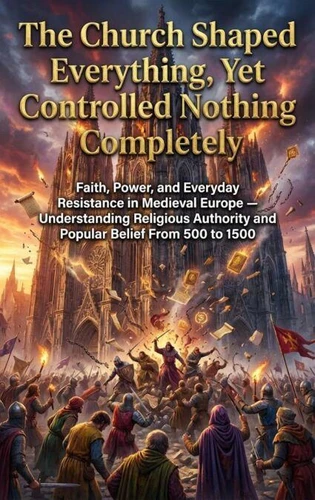
The Church Shaped Everything, Yet Controlled Nothing Completely. Faith, Power, and Everyday Resistance in Medieval Europe — Understanding Religious Authority and Popular Belief From 500 to 1500
Par :Formats :
Disponible dans votre compte client Decitre ou Furet du Nord dès validation de votre commande. Le format ePub est :
- Compatible avec une lecture sur My Vivlio (smartphone, tablette, ordinateur)
- Compatible avec une lecture sur liseuses Vivlio
- Pour les liseuses autres que Vivlio, vous devez utiliser le logiciel Adobe Digital Edition. Non compatible avec la lecture sur les liseuses Kindle, Remarkable et Sony
 , qui est-ce ?
Notre partenaire de plateforme de lecture numérique où vous retrouverez l'ensemble de vos ebooks gratuitement
Pour en savoir plus sur nos ebooks, consultez notre aide en ligne ici
C'est si simple ! Lisez votre ebook avec l'app Vivlio sur votre tablette, mobile ou ordinateur :

- Nombre de pages233
- FormatePub
- ISBN978-3-565-20313-0
- EAN9783565203130
- Date de parution28/01/2026
- Protection num.pas de protection
- Taille2 Mo
- Infos supplémentairesepub
- ÉditeurEmphaloz Publishing House
Résumé
Medieval Europe is often imagined as uniformly pious, with the Church dictating every aspect of life. The reality was far more complex. Religious authority faced constant negotiation: bishops clashed with kings over jurisdiction, monasteries competed for pilgrims and relics, parish priests struggled against folk traditions they could not erase, and lay people practiced Christianity in ways Rome never approved.
This book traces the lived experience of religion across a thousand years.
It examines monastic reform movements that promised spiritual renewal yet accumulated enormous wealth. It follows pilgrimage routes linking distant villages to Jerusalem, Santiago, and Canterbury, revealing religion as commerce, adventure, and penance intertwined. It enters cathedral construction sites, listening to masons, merchants, and bishops argue over sacred geometry and urban prestige. It uncovers popular heresies-Cathars, Waldensians, Lollards-challenging institutional orthodoxy from below. Drawing on parish records, miracle accounts, inquisition trials, and archaeological evidence of shrines and burial practices, this narrative reveals medieval Christianity as negotiation between official doctrine and local custom.
It examines the Crusades as religious violence and economic expansion, the cult of saints as communal identity and political leverage, and the rise of universities as theology became intellectual debate rather than received truth. From rural chapels to papal courts, from mystical visions to liturgical spectacle, this is the story of how religion ordered medieval society yet never fully tamed the messiness of human belief.
Medieval Europe offers insight into the persistence of popular religion despite institutional control, the political uses of sacred authority, and the tension between universal claims and local practice.
It examines monastic reform movements that promised spiritual renewal yet accumulated enormous wealth. It follows pilgrimage routes linking distant villages to Jerusalem, Santiago, and Canterbury, revealing religion as commerce, adventure, and penance intertwined. It enters cathedral construction sites, listening to masons, merchants, and bishops argue over sacred geometry and urban prestige. It uncovers popular heresies-Cathars, Waldensians, Lollards-challenging institutional orthodoxy from below. Drawing on parish records, miracle accounts, inquisition trials, and archaeological evidence of shrines and burial practices, this narrative reveals medieval Christianity as negotiation between official doctrine and local custom.
It examines the Crusades as religious violence and economic expansion, the cult of saints as communal identity and political leverage, and the rise of universities as theology became intellectual debate rather than received truth. From rural chapels to papal courts, from mystical visions to liturgical spectacle, this is the story of how religion ordered medieval society yet never fully tamed the messiness of human belief.
Medieval Europe offers insight into the persistence of popular religion despite institutional control, the political uses of sacred authority, and the tension between universal claims and local practice.
A propos de Talia Westcott









8,49 €
8,99 €