SOLDES
Jusqu'à -70% sur une sélection d'articles*

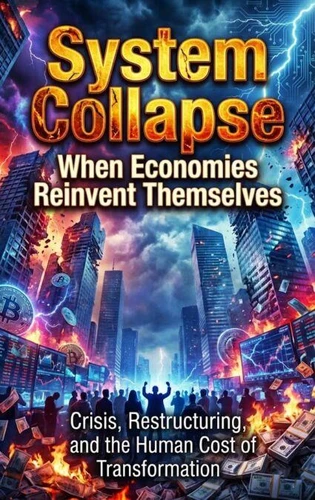
System Collapse: When Economies Reinvent Themselves. Crisis, Restructuring, and the Human Cost of Economic Transformation
Par :Formats :
Disponible dans votre compte client Decitre ou Furet du Nord dès validation de votre commande. Le format ePub est :
- Compatible avec une lecture sur My Vivlio (smartphone, tablette, ordinateur)
- Compatible avec une lecture sur liseuses Vivlio
- Pour les liseuses autres que Vivlio, vous devez utiliser le logiciel Adobe Digital Edition. Non compatible avec la lecture sur les liseuses Kindle, Remarkable et Sony
 , qui est-ce ?
Notre partenaire de plateforme de lecture numérique où vous retrouverez l'ensemble de vos ebooks gratuitement
Pour en savoir plus sur nos ebooks, consultez notre aide en ligne ici
C'est si simple ! Lisez votre ebook avec l'app Vivlio sur votre tablette, mobile ou ordinateur :

- Nombre de pages192
- FormatePub
- ISBN978-3-565-28006-3
- EAN9783565280063
- Date de parution27/02/2026
- Protection num.pas de protection
- Taille2 Mo
- Infos supplémentairesepub
- ÉditeurEmphaloz Publishing House
Résumé
Economic systems do not fail quietly. They collapse through cascading institutional breakdowns-currency crises, sovereign defaults, banking failures, and the sudden evaporation of public confidence in the frameworks that organize daily life. System Collapse examines the most consequential economic reinventions in modern history: the post-WWI hyperinflation and Weimar reconstruction, the Bretton Woods settlement after 1944, the Latin American debt crises of the 1980s, the post-Soviet transition economies of the 1990s, the 2008 global financial restructuring, and the fiscal transformations accelerated by the pandemic era.
Each case represents a moment when the existing economic order became unsustainable and something new had to be built-often under conditions of extreme social stress. Drawing on IMF structural adjustment records, World Bank transition assessments, central bank archives, and the firsthand accounts of economists, policymakers, and ordinary citizens who lived through each transformation, each chapter reconstructs the full anatomy of collapse and reinvention: what failed, who bore the cost, what replaced it, and whose interests shaped the new arrangement.
The book pays particular attention to the human dimension-the wage collapses, pension losses, and community disintegrations that aggregate economic data consistently obscures. The final section examines the structural preconditions visible in contemporary economies: debt-to-GDP ratios at historic highs, central bank balance sheets expanded beyond precedent, and the growing divergence between financial asset valuations and underlying productive capacity.
System Collapse is not a forecast-it is a historical instrument, giving readers the analytical vocabulary to recognize the conditions that have preceded every major economic reinvention, and to understand what transformation, when it comes, actually demands of the societies it reshapes.
Each case represents a moment when the existing economic order became unsustainable and something new had to be built-often under conditions of extreme social stress. Drawing on IMF structural adjustment records, World Bank transition assessments, central bank archives, and the firsthand accounts of economists, policymakers, and ordinary citizens who lived through each transformation, each chapter reconstructs the full anatomy of collapse and reinvention: what failed, who bore the cost, what replaced it, and whose interests shaped the new arrangement.
The book pays particular attention to the human dimension-the wage collapses, pension losses, and community disintegrations that aggregate economic data consistently obscures. The final section examines the structural preconditions visible in contemporary economies: debt-to-GDP ratios at historic highs, central bank balance sheets expanded beyond precedent, and the growing divergence between financial asset valuations and underlying productive capacity.
System Collapse is not a forecast-it is a historical instrument, giving readers the analytical vocabulary to recognize the conditions that have preceded every major economic reinvention, and to understand what transformation, when it comes, actually demands of the societies it reshapes.
A propos de Talia Westcott














8,49 €

8,99 €