Nouveauté
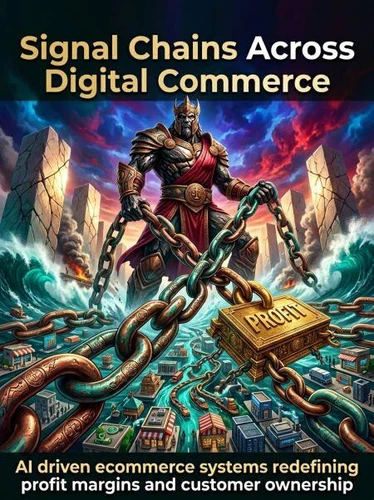
Signal Chains Across Digital Commerce. AI driven ecommerce systems redefining profit margins and customer ownership
Par :Formats :
Disponible dans votre compte client Decitre ou Furet du Nord dès validation de votre commande. Le format ePub est :
- Compatible avec une lecture sur My Vivlio (smartphone, tablette, ordinateur)
- Compatible avec une lecture sur liseuses Vivlio
- Pour les liseuses autres que Vivlio, vous devez utiliser le logiciel Adobe Digital Edition. Non compatible avec la lecture sur les liseuses Kindle, Remarkable et Sony
 , qui est-ce ?
Notre partenaire de plateforme de lecture numérique où vous retrouverez l'ensemble de vos ebooks gratuitement
Pour en savoir plus sur nos ebooks, consultez notre aide en ligne ici
C'est si simple ! Lisez votre ebook avec l'app Vivlio sur votre tablette, mobile ou ordinateur :

- Nombre de pages145
- FormatePub
- ISBN978-3-565-48333-4
- EAN9783565483334
- Date de parution07/06/2026
- Protection num.pas de protection
- Taille1 Mo
- Infos supplémentairesepub
- ÉditeurEmphaloz Publishing House
Résumé
Leadership books for entrepreneurs often focus on growth tactics. This business strategy book examines a different question: why are profitable ecommerce companies separating from the rest despite using similar tools, channels, and advertising platforms. As AI becomes embedded into commerce infrastructure, advantage increasingly comes from decision quality rather than scale alone.
The book analyzes emerging business models expected to dominate 2026 across ecommerce, D2C, and AI-enabled operations.
It explores how companies reduce dependence on paid acquisition by building proprietary customer intelligence systems. It examines the shift from marketplace-driven growth toward owned ecosystems where data, retention, and operational visibility become strategic assets. Special attention is given to AI-assisted forecasting, automated merchandising, pricing systems, customer segmentation, and supply-chain optimization.
Rather than treating AI as a marketing feature, the analysis positions it as an economic layer that influences margins, inventory efficiency, and long-term resilience. The research also investigates why certain D2C brands maintain profitability despite rising acquisition costs and increasing platform dependency. Case patterns reveal how operational structure often matters more than audience size. For European markets facing regulatory pressure, privacy constraints, and changing consumer behavior, these developments suggest a new competitive landscape where intelligent systems become part of business architecture rather than optional tools.
It explores how companies reduce dependence on paid acquisition by building proprietary customer intelligence systems. It examines the shift from marketplace-driven growth toward owned ecosystems where data, retention, and operational visibility become strategic assets. Special attention is given to AI-assisted forecasting, automated merchandising, pricing systems, customer segmentation, and supply-chain optimization.
Rather than treating AI as a marketing feature, the analysis positions it as an economic layer that influences margins, inventory efficiency, and long-term resilience. The research also investigates why certain D2C brands maintain profitability despite rising acquisition costs and increasing platform dependency. Case patterns reveal how operational structure often matters more than audience size. For European markets facing regulatory pressure, privacy constraints, and changing consumer behavior, these developments suggest a new competitive landscape where intelligent systems become part of business architecture rather than optional tools.