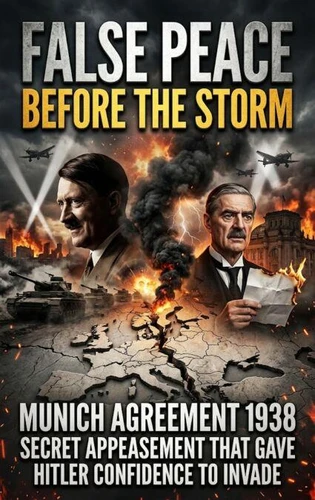
False Peace Before the Storm. Munich Agreement 1938 Secret Appeasement That Gave Hitler Confidence to Invade
Par :Formats :
Disponible dans votre compte client Decitre ou Furet du Nord dès validation de votre commande. Le format ePub est :
- Compatible avec une lecture sur My Vivlio (smartphone, tablette, ordinateur)
- Compatible avec une lecture sur liseuses Vivlio
- Pour les liseuses autres que Vivlio, vous devez utiliser le logiciel Adobe Digital Edition. Non compatible avec la lecture sur les liseuses Kindle, Remarkable et Sony
 , qui est-ce ?
Notre partenaire de plateforme de lecture numérique où vous retrouverez l'ensemble de vos ebooks gratuitement
Pour en savoir plus sur nos ebooks, consultez notre aide en ligne ici
C'est si simple ! Lisez votre ebook avec l'app Vivlio sur votre tablette, mobile ou ordinateur :

- Nombre de pages156
- FormatePub
- ISBN978-3-565-44881-4
- EAN9783565448814
- Date de parution18/05/2026
- Protection num.pas de protection
- Taille1 Mo
- Infos supplémentairesepub
- ÉditeurEmphaloz Publishing House
Résumé
False peace before the storm examines how concealed appeasement emboldens an aggressor, using the Munich Agreement to show how clandestine concessions shifted power balances and paved the way for broader conflict.
The Munich Conference convened Britain, France, Italy, and Germany while excluding Czechoslovakia, thereby removing the affected state from the decision-making process. Neville Chamberlain returned to London claiming he had secured "peace for our time, " interpreting the agreement as a lasting settlement.
Adolf Hitler, however, viewed the concession as confirmation that Britain and France lacked the will to resist further German expansion, which encouraged his subsequent moves. The accord included territorial transfers to Poland and Hungary, designed to isolate Czechoslovakia and prevent Soviet intervention by rewarding potential opponents. These concessions altered the incentive structure for regional actors, making cooperation with Germany more attractive than resistance. Within months, German forces occupied the remainder of Czechoslovakia, demonstrating that appeasement had not sated Hitler's ambitions.
The breach of trust created by the clandestine nature of the deal weakened collective security and hastened the shift toward a confrontational stance in Britain and France. The episode shows how reliance on covert concessions can destabilize diplomatic networks, prompting European powers to reassess the credibility of secret engagements and the transparency of alliance formations.
Adolf Hitler, however, viewed the concession as confirmation that Britain and France lacked the will to resist further German expansion, which encouraged his subsequent moves. The accord included territorial transfers to Poland and Hungary, designed to isolate Czechoslovakia and prevent Soviet intervention by rewarding potential opponents. These concessions altered the incentive structure for regional actors, making cooperation with Germany more attractive than resistance. Within months, German forces occupied the remainder of Czechoslovakia, demonstrating that appeasement had not sated Hitler's ambitions.
The breach of trust created by the clandestine nature of the deal weakened collective security and hastened the shift toward a confrontational stance in Britain and France. The episode shows how reliance on covert concessions can destabilize diplomatic networks, prompting European powers to reassess the credibility of secret engagements and the transparency of alliance formations.