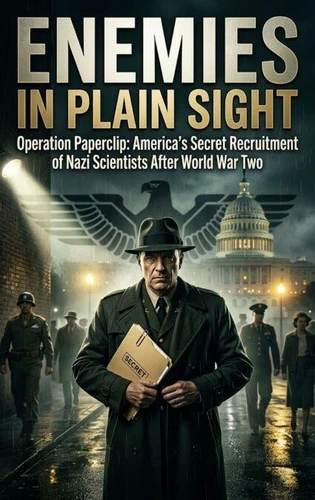
Enemies in Plain Sight. Operation Paperclip America's Secret Recruitment of Nazi Scientists After World War Two
Par :Formats :
Disponible dans votre compte client Decitre ou Furet du Nord dès validation de votre commande. Le format ePub est :
- Compatible avec une lecture sur My Vivlio (smartphone, tablette, ordinateur)
- Compatible avec une lecture sur liseuses Vivlio
- Pour les liseuses autres que Vivlio, vous devez utiliser le logiciel Adobe Digital Edition. Non compatible avec la lecture sur les liseuses Kindle, Remarkable et Sony
 , qui est-ce ?
Notre partenaire de plateforme de lecture numérique où vous retrouverez l'ensemble de vos ebooks gratuitement
Pour en savoir plus sur nos ebooks, consultez notre aide en ligne ici
C'est si simple ! Lisez votre ebook avec l'app Vivlio sur votre tablette, mobile ou ordinateur :

- Nombre de pages155
- FormatePub
- ISBN978-3-565-45195-1
- EAN9783565451951
- Date de parution21/05/2026
- Protection num.pas de protection
- Taille1 Mo
- Infos supplémentairesepub
- ÉditeurEmphaloz Publishing House
Résumé
This book investigates how a nation built on democratic principles systematically dismantled its own ethical frameworks when confronted with geopolitical urgency, examining the institutional mechanisms that allowed former Nazi scientists to be absorbed into the American state apparatus not despite their histories, but in many cases because of their specialized capabilities.
At its core, Operation Paperclip reveals three interlocking systemic tensions: the deliberate distortion of security vetting processes, the structural subordination of moral accountability to Cold War strategic logic, and the redefinition of "enemy" as a fluid geopolitical category.
The Joint Intelligence Objectives Agency actively suppressed or falsified background dossiers to circumvent State Department screening, transforming war criminals into government assets. The program's value was later estimated at billions of dollars in patents and industrial processes, revealing how the American defense-industrial complex developed a transactional relationship with history itself. Information asymmetry within the program was structural, not incidental: the Joint Chiefs of Staff circulated directives that were never shown to President Truman, embedding secrecy not as a safeguard but as a governance mechanism.
These dynamics, including bureaucratic capture, intelligence compartmentalization, and the commodification of human expertise, expose how institutional systems bend when survival logic overrides legal and moral constraints.
The Joint Intelligence Objectives Agency actively suppressed or falsified background dossiers to circumvent State Department screening, transforming war criminals into government assets. The program's value was later estimated at billions of dollars in patents and industrial processes, revealing how the American defense-industrial complex developed a transactional relationship with history itself. Information asymmetry within the program was structural, not incidental: the Joint Chiefs of Staff circulated directives that were never shown to President Truman, embedding secrecy not as a safeguard but as a governance mechanism.
These dynamics, including bureaucratic capture, intelligence compartmentalization, and the commodification of human expertise, expose how institutional systems bend when survival logic overrides legal and moral constraints.