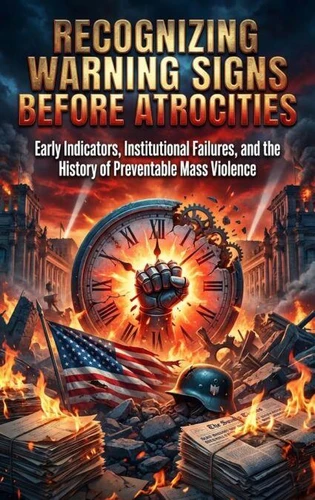
Recognizing Warning Signs Before Atrocities. Early Indicators, Institutional Failures, and the History of Preventable Mass Violence
Par :Formats :
Disponible dans votre compte client Decitre ou Furet du Nord dès validation de votre commande. Le format ePub est :
- Compatible avec une lecture sur My Vivlio (smartphone, tablette, ordinateur)
- Compatible avec une lecture sur liseuses Vivlio
- Pour les liseuses autres que Vivlio, vous devez utiliser le logiciel Adobe Digital Edition. Non compatible avec la lecture sur les liseuses Kindle, Remarkable et Sony
 , qui est-ce ?
Notre partenaire de plateforme de lecture numérique où vous retrouverez l'ensemble de vos ebooks gratuitement
Pour en savoir plus sur nos ebooks, consultez notre aide en ligne ici
C'est si simple ! Lisez votre ebook avec l'app Vivlio sur votre tablette, mobile ou ordinateur :

- Nombre de pages217
- FormatePub
- ISBN978-3-565-27206-8
- EAN9783565272068
- Date de parution25/02/2026
- Protection num.pas de protection
- Taille2 Mo
- Infos supplémentairesepub
- ÉditeurEmphaloz Publishing House
Résumé
History's worst atrocities rarely arrived without warning. From the genocide in Rwanda to the Holocaust and the Cambodian killing fields, survivors, journalists, and diplomats later recalled the signs-dehumanizing rhetoric, targeted legislation, escalating exclusion-that preceded mass violence. Yet those warnings were ignored, dismissed, or deliberately suppressed.
This book examines the documented patterns that emerge before genocides and mass atrocities unfold, drawing on historical records, survivor testimony, and policy analyses.
It traces how warning signs were identified-or failed to be-by governments, international bodies, and civil society, and explores the structural reasons why early intervention so often fell short. Grounded in case studies from the twentieth and twenty-first centuries, the book offers a rigorous framework for understanding how ordinary societies slide toward extraordinary violence. It does not sensationalize tragedy but instead foregrounds the human and institutional choices made at critical junctures.
For readers seeking to understand not just what happened, but why the world so often failed to act in time, this is an essential historical reckoning.
It traces how warning signs were identified-or failed to be-by governments, international bodies, and civil society, and explores the structural reasons why early intervention so often fell short. Grounded in case studies from the twentieth and twenty-first centuries, the book offers a rigorous framework for understanding how ordinary societies slide toward extraordinary violence. It does not sensationalize tragedy but instead foregrounds the human and institutional choices made at critical junctures.
For readers seeking to understand not just what happened, but why the world so often failed to act in time, this is an essential historical reckoning.