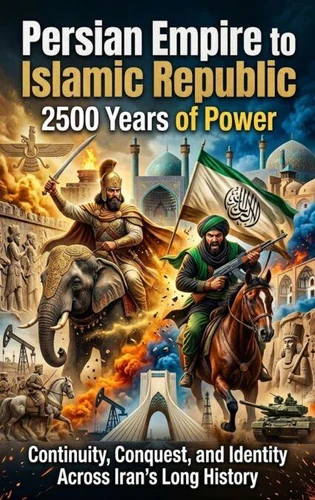
Persian Empire to Islamic Republic: 2500 Years of Power. Continuity, Conquest, and Identity Across Iran's Long History
Par :Formats :
Disponible dans votre compte client Decitre ou Furet du Nord dès validation de votre commande. Le format ePub est :
- Compatible avec une lecture sur My Vivlio (smartphone, tablette, ordinateur)
- Compatible avec une lecture sur liseuses Vivlio
- Pour les liseuses autres que Vivlio, vous devez utiliser le logiciel Adobe Digital Edition. Non compatible avec la lecture sur les liseuses Kindle, Remarkable et Sony
 , qui est-ce ?
Notre partenaire de plateforme de lecture numérique où vous retrouverez l'ensemble de vos ebooks gratuitement
Pour en savoir plus sur nos ebooks, consultez notre aide en ligne ici
C'est si simple ! Lisez votre ebook avec l'app Vivlio sur votre tablette, mobile ou ordinateur :

- Nombre de pages171
- FormatePub
- ISBN978-3-565-32249-7
- EAN9783565322497
- Date de parution14/03/2026
- Protection num.pas de protection
- Taille2 Mo
- Infos supplémentairesepub
- ÉditeurEmphaloz Publishing House
Résumé
Few nations carry the weight of history as visibly as Iran. From Cyrus the Great's proclamation of the world's first human rights charter to the 1979 revolution that reshaped the modern Middle East, the lands of Persia have been a continuous theater of empire, faith, and reinvention. Yet the through-lines connecting ancient Achaemenid ambition to contemporary theocratic governance remain underexplored in mainstream historical literature.
This book traces Iran's 2, 500-year arc not as a sequence of disconnected dynasties, but as an evolving negotiation between centralized power, religious authority, and national identity.
It examines how Persian imperial culture survived Greek conquest, Arab invasion, and Mongol devastation-each time absorbing outside forces while reasserting a distinct civilizational core. It follows the Safavid transformation of Shia Islam into a state ideology, the Qajar empire's collision with European colonialism, and the Pahlavi monarchy's turbulent modernization project. Drawing on archaeological evidence, classical sources, and modern historiography, this is an accessible yet rigorous account of how one civilization's long memory continues to shape its present politics, culture, and place in the world.
It examines how Persian imperial culture survived Greek conquest, Arab invasion, and Mongol devastation-each time absorbing outside forces while reasserting a distinct civilizational core. It follows the Safavid transformation of Shia Islam into a state ideology, the Qajar empire's collision with European colonialism, and the Pahlavi monarchy's turbulent modernization project. Drawing on archaeological evidence, classical sources, and modern historiography, this is an accessible yet rigorous account of how one civilization's long memory continues to shape its present politics, culture, and place in the world.