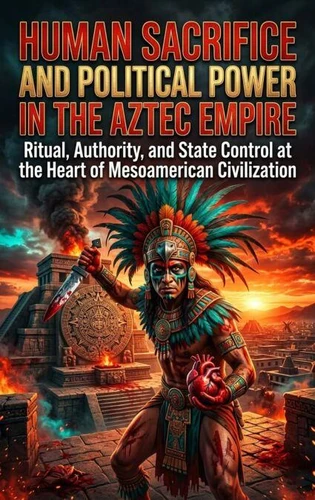
Human Sacrifice and Political Power in the Aztec Empire. Ritual, Authority, and State Control at the Heart of Mesoamerican Civilization
Par :Formats :
Disponible dans votre compte client Decitre ou Furet du Nord dès validation de votre commande. Le format ePub est :
- Compatible avec une lecture sur My Vivlio (smartphone, tablette, ordinateur)
- Compatible avec une lecture sur liseuses Vivlio
- Pour les liseuses autres que Vivlio, vous devez utiliser le logiciel Adobe Digital Edition. Non compatible avec la lecture sur les liseuses Kindle, Remarkable et Sony
 , qui est-ce ?
Notre partenaire de plateforme de lecture numérique où vous retrouverez l'ensemble de vos ebooks gratuitement
Pour en savoir plus sur nos ebooks, consultez notre aide en ligne ici
C'est si simple ! Lisez votre ebook avec l'app Vivlio sur votre tablette, mobile ou ordinateur :

- Nombre de pages226
- FormatePub
- ISBN978-3-565-32662-4
- EAN9783565326624
- Date de parution15/03/2026
- Protection num.pas de protection
- Taille2 Mo
- Infos supplémentairesepub
- ÉditeurEmphaloz Publishing House
Résumé
Few practices in human history have been as misrepresented as Aztec ritual sacrifice. Stripped of context by conquest-era Spanish chroniclers and sensationalized by centuries of Western retelling, the rite has obscured far more than it has revealed. This book restores what that distortion removed: a coherent political and religious system in which sacrifice was not spectacle, but statecraft.
Drawing on Nahuatl codices, excavation records from the Templo Mayor, and recent forensic archaeology, this history examines how the Aztec state used ritual killing as a technology of power.
Sacrifice sanctified the emperor's authority, bound subordinate city-states through terror and obligation, and anchored a cosmic worldview in which human blood sustained the sun itself. To rule in Tenochtitlan was to control the boundary between human and divine order. This book traces that system from its ideological foundations through its administrative machinery, asking how a society organized around ritual death also produced extraordinary art, architecture, and diplomatic sophistication.
It does not justify-it explains. And in explaining, it reveals an empire whose inner logic was far more coherent, and far more human, than the caricature history inherited from its conquerors.
Sacrifice sanctified the emperor's authority, bound subordinate city-states through terror and obligation, and anchored a cosmic worldview in which human blood sustained the sun itself. To rule in Tenochtitlan was to control the boundary between human and divine order. This book traces that system from its ideological foundations through its administrative machinery, asking how a society organized around ritual death also produced extraordinary art, architecture, and diplomatic sophistication.
It does not justify-it explains. And in explaining, it reveals an empire whose inner logic was far more coherent, and far more human, than the caricature history inherited from its conquerors.