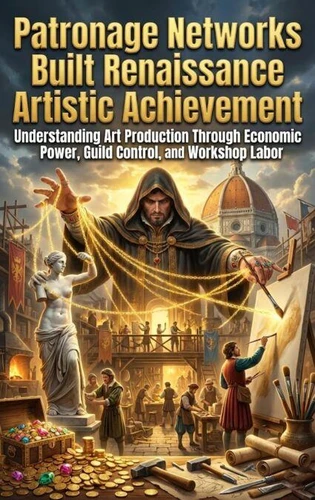
Patronage Networks Built Renaissance Artistic Achievement. Understanding Art Production Through Economic Power, Guild Control, and Workshop Labor
Par :Formats :
Disponible dans votre compte client Decitre ou Furet du Nord dès validation de votre commande. Le format ePub est :
- Compatible avec une lecture sur My Vivlio (smartphone, tablette, ordinateur)
- Compatible avec une lecture sur liseuses Vivlio
- Pour les liseuses autres que Vivlio, vous devez utiliser le logiciel Adobe Digital Edition. Non compatible avec la lecture sur les liseuses Kindle, Remarkable et Sony
 , qui est-ce ?
Notre partenaire de plateforme de lecture numérique où vous retrouverez l'ensemble de vos ebooks gratuitement
Pour en savoir plus sur nos ebooks, consultez notre aide en ligne ici
C'est si simple ! Lisez votre ebook avec l'app Vivlio sur votre tablette, mobile ou ordinateur :

- Nombre de pages190
- FormatePub
- ISBN978-3-565-20756-5
- EAN9783565207565
- Date de parution29/01/2026
- Protection num.pas de protection
- Taille2 Mo
- Infos supplémentairesepub
- ÉditeurEmphaloz Publishing House
Résumé
The Renaissance celebrates individual genius-Michelangelo, Leonardo, Raphael. Yet this narrative of solitary brilliance overlooks the economic and social structures that made masterpieces possible: wealthy families competing for political legitimacy through commissioned art, guild regulations determining who could legally practice, and workshop systems where dozens of assistants executed the master's designs.
This book reexamines Renaissance art through contracts, payment records, guild documents, and workshop inventories.
It traces how art functioned as political currency for the Medici and other banking families, how artists navigated between creative vision and patron demands, and how marble quarrying, pigment trade, and apprenticeship networks shaped what could actually be produced. The focus extends beyond famous names to include the skilled laborers-plasterers, gilders, stone carvers-whose work remained anonymous. By analyzing the material conditions of artistic production, this work reveals how Renaissance achievement emerged from collaborative labor embedded in specific economic relationships.
It asks: when we admire a painting, whose genius are we really witnessing-the individual artist or the entire system that sustained their work?
It traces how art functioned as political currency for the Medici and other banking families, how artists navigated between creative vision and patron demands, and how marble quarrying, pigment trade, and apprenticeship networks shaped what could actually be produced. The focus extends beyond famous names to include the skilled laborers-plasterers, gilders, stone carvers-whose work remained anonymous. By analyzing the material conditions of artistic production, this work reveals how Renaissance achievement emerged from collaborative labor embedded in specific economic relationships.
It asks: when we admire a painting, whose genius are we really witnessing-the individual artist or the entire system that sustained their work?