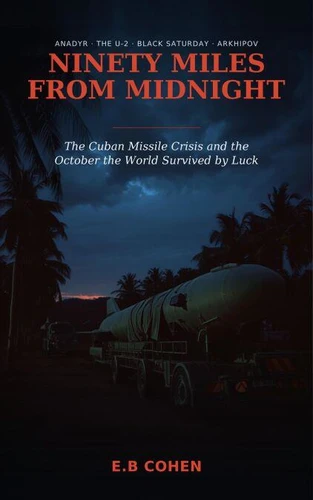
In October 1962, for thirteen days, the world came closer to destroying itself than it ever has before or since. Everyone knows the story: a young president faced down the Soviet Union, refused his generals' demands to bomb, and forced Nikita Khrushchev to back away. Kennedy stared them down, and they blinked. Almost none of it is true. In Ninety Miles from Midnight, E. B Cohen tells the Cuban Missile Crisis as sixty years of declassification have actually revealed it - and shows that the version we remember was manufactured six weeks after the fact, in a magazine article written by the President's best friend with the President's blessing.
Kennedy did not face Khrushchev down. He traded away American missiles in Turkey in a secret deal his own brother's memoir was edited to conceal, and he was preparing to make that trade publicly if he had to. The ships never met at the quarantine line. The famous "Trollope ploy" never happened. And the crisis was vastly more dangerous than any of the men managing it understood: ninety-eight tactical nuclear warheads were already on Cuba with commanders who did not need Moscow's permission, a Soviet submarine captain in the Sargasso Sea very nearly fired a nuclear torpedo, and an American U-2 pilot got lost over Siberia at the worst possible hour of the worst possible day.
Beginning in 1898 and ending in the archives of the present, Cohen tells the whole story: the island the United States could not stop treating as property, the secret war that gave Khrushchev his pretext, the deception operation that issued skis to soldiers bound for the tropics, the thirteen days themselves in unprecedented detail, and the long November after the famous part ended, when the warheads were still there and Fidel Castro did not want to give them back.
Along the way he explains the machinery from first principles - how an R-12 missile works, what a photo-interpreter actually sees on a light table, why a diesel submarine's dying batteries can decide the fate of the world. Even-handed, gripping, and built entirely on the post-myth record, this is the story of a man who managed, better than nearly everyone in the room wanted him to, a crisis he had helped to cause - and then lied about how he ended it.
And of a world that survived not because the system worked, but because, four or five times over, it got lucky.
In October 1962, for thirteen days, the world came closer to destroying itself than it ever has before or since. Everyone knows the story: a young president faced down the Soviet Union, refused his generals' demands to bomb, and forced Nikita Khrushchev to back away. Kennedy stared them down, and they blinked. Almost none of it is true. In Ninety Miles from Midnight, E. B Cohen tells the Cuban Missile Crisis as sixty years of declassification have actually revealed it - and shows that the version we remember was manufactured six weeks after the fact, in a magazine article written by the President's best friend with the President's blessing.
Kennedy did not face Khrushchev down. He traded away American missiles in Turkey in a secret deal his own brother's memoir was edited to conceal, and he was preparing to make that trade publicly if he had to. The ships never met at the quarantine line. The famous "Trollope ploy" never happened. And the crisis was vastly more dangerous than any of the men managing it understood: ninety-eight tactical nuclear warheads were already on Cuba with commanders who did not need Moscow's permission, a Soviet submarine captain in the Sargasso Sea very nearly fired a nuclear torpedo, and an American U-2 pilot got lost over Siberia at the worst possible hour of the worst possible day.
Beginning in 1898 and ending in the archives of the present, Cohen tells the whole story: the island the United States could not stop treating as property, the secret war that gave Khrushchev his pretext, the deception operation that issued skis to soldiers bound for the tropics, the thirteen days themselves in unprecedented detail, and the long November after the famous part ended, when the warheads were still there and Fidel Castro did not want to give them back.
Along the way he explains the machinery from first principles - how an R-12 missile works, what a photo-interpreter actually sees on a light table, why a diesel submarine's dying batteries can decide the fate of the world. Even-handed, gripping, and built entirely on the post-myth record, this is the story of a man who managed, better than nearly everyone in the room wanted him to, a crisis he had helped to cause - and then lied about how he ended it.
And of a world that survived not because the system worked, but because, four or five times over, it got lucky.


 , qui est-ce ?