SOLDES
Jusqu'à -70% sur une sélection d'articles*

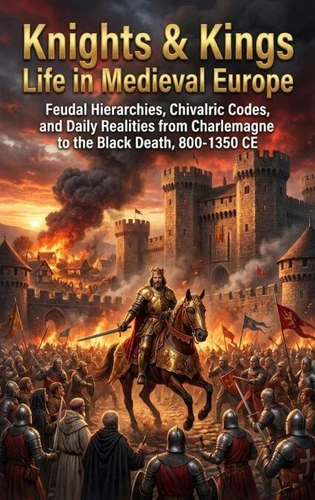
Knights & Kings: Life in Medieval Europe. Feudal Hierarchies, Chivalric Codes, and Daily Realities from Charlemagne to the Black Death, 800-1350 CE
Par :Formats :
Disponible dans votre compte client Decitre ou Furet du Nord dès validation de votre commande. Le format ePub est :
- Compatible avec une lecture sur My Vivlio (smartphone, tablette, ordinateur)
- Compatible avec une lecture sur liseuses Vivlio
- Pour les liseuses autres que Vivlio, vous devez utiliser le logiciel Adobe Digital Edition. Non compatible avec la lecture sur les liseuses Kindle, Remarkable et Sony
 , qui est-ce ?
Notre partenaire de plateforme de lecture numérique où vous retrouverez l'ensemble de vos ebooks gratuitement
Pour en savoir plus sur nos ebooks, consultez notre aide en ligne ici
C'est si simple ! Lisez votre ebook avec l'app Vivlio sur votre tablette, mobile ou ordinateur :

- Nombre de pages232
- FormatePub
- ISBN978-3-565-25086-8
- EAN9783565250868
- Date de parution16/02/2026
- Protection num.pas de protection
- Taille2 Mo
- Infos supplémentairesepub
- ÉditeurEmphaloz Publishing House
Résumé
Medieval Europe's social pyramid rested on intricate bonds of loyalty, obligation, and violence-a world where armored warriors swore fealty to monarchs, peasants labored on manorial estates, and the Church claimed authority over souls and kingdoms alike. This history examines how feudal society actually functioned beneath the veneer of chivalric romance.
Drawing on monastic chronicles, legal documents, archaeological excavations, and material culture, the narrative reconstructs daily existence across social strata.
Royal courts administered justice and diplomacy while managing fractious nobles. Knights trained for warfare from childhood, their martial prowess celebrated in tournaments yet brutally deployed in territorial conflicts and crusades. Chivalric codes prescribed honor and courtesy, but practice often diverged sharply from ideal-violence, plunder, and political calculation shaped knightly behavior as much as courtly virtue. The book traces political structures from Charlemagne's Carolingian reforms through the consolidation of dynastic kingdoms and the tensions between centralized authority and local power.
It explores castle construction and siege warfare, the manor economy's agricultural rhythms, guild organization in growing towns, and monastic life's intellectual contributions. Religious authority permeated governance, yet secular rulers constantly negotiated boundaries with papal claims. Beyond elite politics, the analysis reveals how ordinary people navigated rigid hierarchies-serfs bound to land, women managing households and estates, Jewish communities facing periodic persecution, and gradual social mobility through commerce and military service.
The devastating impact of famine and plague in the fourteenth century exposed feudalism's vulnerabilities, accelerating transformations already underway.
Royal courts administered justice and diplomacy while managing fractious nobles. Knights trained for warfare from childhood, their martial prowess celebrated in tournaments yet brutally deployed in territorial conflicts and crusades. Chivalric codes prescribed honor and courtesy, but practice often diverged sharply from ideal-violence, plunder, and political calculation shaped knightly behavior as much as courtly virtue. The book traces political structures from Charlemagne's Carolingian reforms through the consolidation of dynastic kingdoms and the tensions between centralized authority and local power.
It explores castle construction and siege warfare, the manor economy's agricultural rhythms, guild organization in growing towns, and monastic life's intellectual contributions. Religious authority permeated governance, yet secular rulers constantly negotiated boundaries with papal claims. Beyond elite politics, the analysis reveals how ordinary people navigated rigid hierarchies-serfs bound to land, women managing households and estates, Jewish communities facing periodic persecution, and gradual social mobility through commerce and military service.
The devastating impact of famine and plague in the fourteenth century exposed feudalism's vulnerabilities, accelerating transformations already underway.
A propos de Celeste Rowan











8,99 €