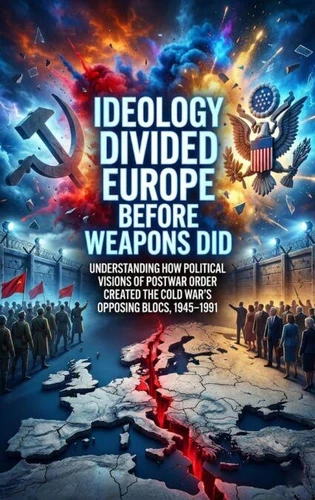
Ideology Divided Europe Before Weapons Did. Understanding How Political Visions of Postwar Order Created the Cold War's Opposing Blocs, 1945–1991
Par :Formats :
Disponible dans votre compte client Decitre ou Furet du Nord dès validation de votre commande. Le format ePub est :
- Compatible avec une lecture sur My Vivlio (smartphone, tablette, ordinateur)
- Compatible avec une lecture sur liseuses Vivlio
- Pour les liseuses autres que Vivlio, vous devez utiliser le logiciel Adobe Digital Edition. Non compatible avec la lecture sur les liseuses Kindle, Remarkable et Sony
 , qui est-ce ?
Notre partenaire de plateforme de lecture numérique où vous retrouverez l'ensemble de vos ebooks gratuitement
Pour en savoir plus sur nos ebooks, consultez notre aide en ligne ici
C'est si simple ! Lisez votre ebook avec l'app Vivlio sur votre tablette, mobile ou ordinateur :

- Nombre de pages234
- FormatePub
- ISBN978-3-565-21084-8
- EAN9783565210848
- Date de parution30/01/2026
- Protection num.pas de protection
- Taille2 Mo
- Infos supplémentairesepub
- ÉditeurEmphaloz Publishing House
Résumé
The Cold War emerged not inevitably from World War II's end but from fundamentally incompatible visions of political and economic organization. This book examines how American liberal capitalism and Soviet communism-both claiming universal validity-transformed wartime allies into adversaries whose competition shaped global politics for half a century without direct military confrontation between superpowers.
Through declassified diplomatic cables, party archives, parliamentary debates, intelligence assessments, and firsthand accounts from political actors across the Iron Curtain, the narrative traces how ideological commitments hardened into rigid blocs.
The book follows key moments: disagreements over Poland's government, the Marshall Plan's economic reconstruction linking Western Europe to American markets, the Berlin Blockade testing resolve, NATO and Warsaw Pact formalizing military divisions. Beyond superpower capitals, the narrative explores how Cold War logic penetrated domestic politics throughout Europe-anticommunist purges in the West, suppression of dissent in the East, neutral nations navigating impossible pressures.
It examines how both systems justified authoritarianism through external threat: McCarthyism and surveillance states in Western democracies, show trials and closed borders in Eastern bloc countries. The book analyzes détente's possibilities and limitations, Solidarity's challenge to Soviet control, Gorbachev's reforms intended to save communism that instead enabled its collapse, and reunification's complexities.
It questions triumphalist narratives by examining economic exhaustion, systemic failures, and popular resistance that undermined Soviet authority alongside Western pressure.
The book follows key moments: disagreements over Poland's government, the Marshall Plan's economic reconstruction linking Western Europe to American markets, the Berlin Blockade testing resolve, NATO and Warsaw Pact formalizing military divisions. Beyond superpower capitals, the narrative explores how Cold War logic penetrated domestic politics throughout Europe-anticommunist purges in the West, suppression of dissent in the East, neutral nations navigating impossible pressures.
It examines how both systems justified authoritarianism through external threat: McCarthyism and surveillance states in Western democracies, show trials and closed borders in Eastern bloc countries. The book analyzes détente's possibilities and limitations, Solidarity's challenge to Soviet control, Gorbachev's reforms intended to save communism that instead enabled its collapse, and reunification's complexities.
It questions triumphalist narratives by examining economic exhaustion, systemic failures, and popular resistance that undermined Soviet authority alongside Western pressure.