Celeste Rowan is a nonfiction author known for writing reflective books on mindfulness, emotional resilience, and intentional living. Her calm and thoughtful approach blends psychology, philosophy, and everyday wisdom to help readers cultivate greater balance, clarity, and inner peace.
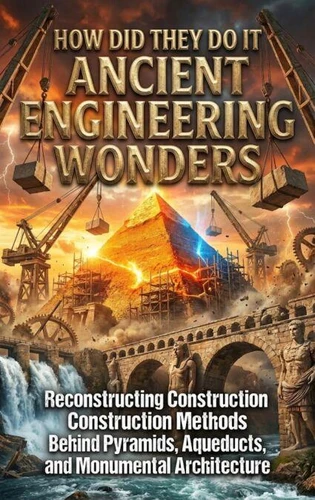
How Did They Do It: Ancient Engineering Wonders. Reconstructing Construction Methods Behind Pyramids, Aqueducts, and Monumental Architecture
Par :Formats :
Disponible dans votre compte client Decitre ou Furet du Nord dès validation de votre commande. Le format ePub est :
- Compatible avec une lecture sur My Vivlio (smartphone, tablette, ordinateur)
- Compatible avec une lecture sur liseuses Vivlio
- Pour les liseuses autres que Vivlio, vous devez utiliser le logiciel Adobe Digital Edition. Non compatible avec la lecture sur les liseuses Kindle, Remarkable et Sony
 , qui est-ce ?
Notre partenaire de plateforme de lecture numérique où vous retrouverez l'ensemble de vos ebooks gratuitement
Pour en savoir plus sur nos ebooks, consultez notre aide en ligne ici
C'est si simple ! Lisez votre ebook avec l'app Vivlio sur votre tablette, mobile ou ordinateur :

- Nombre de pages154
- FormatePub
- ISBN978-3-565-25378-4
- EAN9783565253784
- Date de parution17/02/2026
- Protection num.pas de protection
- Taille2 Mo
- Infos supplémentairesepub
- ÉditeurEmphaloz Publishing House
Résumé
Ancient civilizations achieved engineering feats that challenge modern understanding, constructing monuments whose precision and scale seem impossible given available technology. This exploration examines how societies without modern machinery built structures like Egyptian pyramids, Roman aqueducts, Inca stonework, and Gothic cathedrals, using archaeological evidence, experimental archaeology, and engineering analysis to reconstruct plausible construction methods.
Through systematic investigation of tool marks, quarry sites, ramp remains, and structural analysis, discover the practical solutions ancient engineers developed.
Examine how Egyptians moved multi-ton blocks using sledges, rollers, and coordinated labor rather than mythical lost technologies. Witness how Roman engineers calculated aqueduct gradients with remarkable precision using simple leveling instruments. Understand how Inca masons achieved earthquake-resistant masonry through empirical experimentation rather than theoretical knowledge. Archaeological evidence-abandoned quarries, unfinished monuments, construction debris, tool assemblages-provides concrete information about techniques.
Experimental archaeology, where researchers attempt reconstruction using period-appropriate methods, tests hypotheses about feasibility and labor requirements. Engineering analysis reveals how ancient builders understood structural principles through practice even without formal mathematical theory. Each case study examines specific monuments and their construction contexts. Understand how social organization enabled massive labor mobilization, how religious or political motivations justified enormous resource investment, how incremental technological improvements accumulated across generations, and how practical problem-solving rather than mysterious lost knowledge explains achievements that continue inspiring wonder.
Examine how Egyptians moved multi-ton blocks using sledges, rollers, and coordinated labor rather than mythical lost technologies. Witness how Roman engineers calculated aqueduct gradients with remarkable precision using simple leveling instruments. Understand how Inca masons achieved earthquake-resistant masonry through empirical experimentation rather than theoretical knowledge. Archaeological evidence-abandoned quarries, unfinished monuments, construction debris, tool assemblages-provides concrete information about techniques.
Experimental archaeology, where researchers attempt reconstruction using period-appropriate methods, tests hypotheses about feasibility and labor requirements. Engineering analysis reveals how ancient builders understood structural principles through practice even without formal mathematical theory. Each case study examines specific monuments and their construction contexts. Understand how social organization enabled massive labor mobilization, how religious or political motivations justified enormous resource investment, how incremental technological improvements accumulated across generations, and how practical problem-solving rather than mysterious lost knowledge explains achievements that continue inspiring wonder.