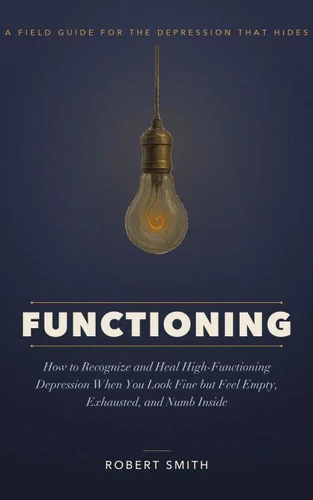
You look fine. Inside, the color has drained out of everything. You get up. You go to work, and you are good at it. You answer the messages, pay the bills, show up to the dinners. By every visible measure you are functioning. That is exactly why no one, not your friends, not your doctor, not even you, has ever named the thing you have been quietly carrying for years. It is called high-functioning depression, and the very competence everyone praises is part of what keeps you from getting help.
You assume depression means being unable to get out of bed, so because you got up, made the coffee, and led the meeting, you call it stress, or a phase, or your personality, anything but what it is. Functioning is about the depression that hides. Written in a warm, unflinching voice and grounded in the work of Aaron Beck, David Burns, Andrew Solomon, and Johann Hari, along with the research on anhedonia and behavioral activation, it gives you the word, the understanding, and, above all, the tools.
Across three parts and fifteen chapters:- How to recognize the symptoms that do not look like symptoms, the flatness, the joyless competence, the exhaustion sleep cannot fix - Why you, the people who love you, and even your doctor have missed it for so long, and how persistent depressive disorder (dysthymia) hides as personality - The machinery underneath: anhedonia, the flattened inner voice that calls itself realism, and how busyness becomes a place to hide - The single best-evidenced truth in depression recovery, that action comes before motivation, not after - How to rebuild the capacity for pleasure, tend the physical floor of mood, and know when and how to get professional helpEvery chapter ends with a Protocol, not an affirmation but a specific, bounded thing to do: an inventory, a log, an experiment, a script.
Fifteen chapters, fifteen protocols, for the mornings the day feels like wet sand. You are not broken, not ungrateful, and not making it up. You are depressed in a way the world is set up to miss. This book is how you stop missing it, and how you turn the light back up. If you are in crisis or having thoughts of self-harm, please reach a professional now. In the US, call or text 988.
You look fine. Inside, the color has drained out of everything. You get up. You go to work, and you are good at it. You answer the messages, pay the bills, show up to the dinners. By every visible measure you are functioning. That is exactly why no one, not your friends, not your doctor, not even you, has ever named the thing you have been quietly carrying for years. It is called high-functioning depression, and the very competence everyone praises is part of what keeps you from getting help.
You assume depression means being unable to get out of bed, so because you got up, made the coffee, and led the meeting, you call it stress, or a phase, or your personality, anything but what it is. Functioning is about the depression that hides. Written in a warm, unflinching voice and grounded in the work of Aaron Beck, David Burns, Andrew Solomon, and Johann Hari, along with the research on anhedonia and behavioral activation, it gives you the word, the understanding, and, above all, the tools.
Across three parts and fifteen chapters:- How to recognize the symptoms that do not look like symptoms, the flatness, the joyless competence, the exhaustion sleep cannot fix - Why you, the people who love you, and even your doctor have missed it for so long, and how persistent depressive disorder (dysthymia) hides as personality - The machinery underneath: anhedonia, the flattened inner voice that calls itself realism, and how busyness becomes a place to hide - The single best-evidenced truth in depression recovery, that action comes before motivation, not after - How to rebuild the capacity for pleasure, tend the physical floor of mood, and know when and how to get professional helpEvery chapter ends with a Protocol, not an affirmation but a specific, bounded thing to do: an inventory, a log, an experiment, a script.
Fifteen chapters, fifteen protocols, for the mornings the day feels like wet sand. You are not broken, not ungrateful, and not making it up. You are depressed in a way the world is set up to miss. This book is how you stop missing it, and how you turn the light back up. If you are in crisis or having thoughts of self-harm, please reach a professional now. In the US, call or text 988.


 , qui est-ce ?