A twinge becomes a tumor between one breath and the next. That is where health anxiety lives, and it is far more treatable than it feels from the inside. A skipped heartbeat becomes a cardiac event. A headache that lasts a day too long becomes the thing you read about at 2 a.m. in the blue light of a phone held six inches from your face. You have been to the doctor. The scans found nothing. You felt better for three days, and then the dread came back, exactly as loud as before.
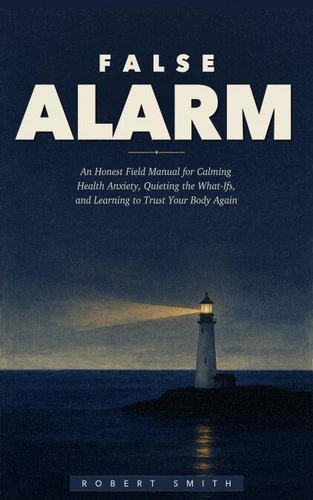
You are not a hypochondriac in the cruel, comic sense the word has carried for two thousand years. You are a person whose alarm system has learned to fire when there is no fire, whose ancient, life-saving warning circuit has been turned up so high that ordinary sensation now reads as catastrophe. False Alarm is a warm, direct, unflinching guide to health anxiety, written in plain English, grounded in the published research on illness anxiety, interoception, and acceptance-based therapy, and built around the daily, learnable practice that turns the alarm back down.
Across fifteen chapters and fifteen time-bounded Practices, Robert Smith works through three movements. Recognition: what health anxiety actually is, why a clean scan calms you for about three days, and the difference between the checker and the avoider. The loop: how checking, googling, and reassurance-seeking are the engine that keeps the fear alive, and why the real driver underneath it is not illness but an unbearable demand for certainty.
The practice: letting a sensation arrive without obeying it, building a life larger than the fear, and using real medical care wisely without letting it become fuel. Inside:- Why a body that feels this alarming so rarely turns out to be a body that is dying, and the science of how the brain builds the experience of sensation rather than simply reading it - The Search Fast, a 72-hour protocol that breaks the cyberchondria spiral - Why reassurance never lasts, and how every "you're fine" quietly trains your brain to need the next one - How body-scanning manufactures the very symptoms it was meant to rule out - The Reassurance Fast and the Safety-Behavior Inventory, for the rituals you no longer notice - The 90-Second Sit, the somatic practice that lets a fear wave crest and pass on its own - How to see a doctor without feeding the loop, the One-Appointment Rule - When self-help is not enough, and exactly what to look for in a clinicianIt is for the person lying awake at 3 a.m.
with a hand on their own pulse, counting, certain that this is the night it finally means something, and for the partner, parent, or friend who has watched someone they love disappear into a fear they could not reach. For readers of Overcoming Health Anxiety by David Veale and Rob Willson, Freedom from Health Anxiety by Karen Lynn Cassiday, and Stopping the Noise in Your Head by Reid Wilson. The alarm did not get this loud overnight, and it will not go quiet overnight either.
But it does go quiet. You can learn to put your hand down.
A twinge becomes a tumor between one breath and the next. That is where health anxiety lives, and it is far more treatable than it feels from the inside. A skipped heartbeat becomes a cardiac event. A headache that lasts a day too long becomes the thing you read about at 2 a.m. in the blue light of a phone held six inches from your face. You have been to the doctor. The scans found nothing. You felt better for three days, and then the dread came back, exactly as loud as before.
You are not a hypochondriac in the cruel, comic sense the word has carried for two thousand years. You are a person whose alarm system has learned to fire when there is no fire, whose ancient, life-saving warning circuit has been turned up so high that ordinary sensation now reads as catastrophe. False Alarm is a warm, direct, unflinching guide to health anxiety, written in plain English, grounded in the published research on illness anxiety, interoception, and acceptance-based therapy, and built around the daily, learnable practice that turns the alarm back down.
Across fifteen chapters and fifteen time-bounded Practices, Robert Smith works through three movements. Recognition: what health anxiety actually is, why a clean scan calms you for about three days, and the difference between the checker and the avoider. The loop: how checking, googling, and reassurance-seeking are the engine that keeps the fear alive, and why the real driver underneath it is not illness but an unbearable demand for certainty.
The practice: letting a sensation arrive without obeying it, building a life larger than the fear, and using real medical care wisely without letting it become fuel. Inside:- Why a body that feels this alarming so rarely turns out to be a body that is dying, and the science of how the brain builds the experience of sensation rather than simply reading it - The Search Fast, a 72-hour protocol that breaks the cyberchondria spiral - Why reassurance never lasts, and how every "you're fine" quietly trains your brain to need the next one - How body-scanning manufactures the very symptoms it was meant to rule out - The Reassurance Fast and the Safety-Behavior Inventory, for the rituals you no longer notice - The 90-Second Sit, the somatic practice that lets a fear wave crest and pass on its own - How to see a doctor without feeding the loop, the One-Appointment Rule - When self-help is not enough, and exactly what to look for in a clinicianIt is for the person lying awake at 3 a.m.
with a hand on their own pulse, counting, certain that this is the night it finally means something, and for the partner, parent, or friend who has watched someone they love disappear into a fear they could not reach. For readers of Overcoming Health Anxiety by David Veale and Rob Willson, Freedom from Health Anxiety by Karen Lynn Cassiday, and Stopping the Noise in Your Head by Reid Wilson. The alarm did not get this loud overnight, and it will not go quiet overnight either.
But it does go quiet. You can learn to put your hand down.

 , qui est-ce ?