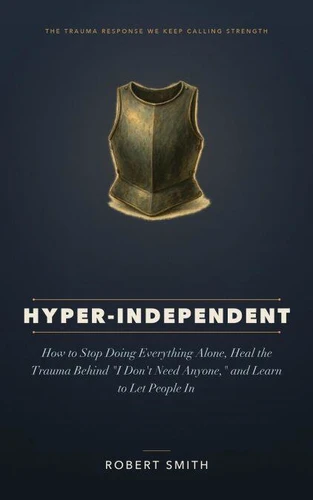
Everyone calls you strong. So why does being this capable feel so much like being alone?You are the one who handles it. You do not ask for help, you do not lean, you do not let anyone carry the weight, and people admire you for it. But under the competence is a quieter truth: you are exhausted, you are lonely inside your relationships, and you cannot remember the last time you let someone all the way in.
What you are carrying has a name. Hyper-independence is not a personality trait. It is a trauma response, a survival strategy you built, intelligently, in a world where depending on people got you let down, burdened, or met with no one there. So you learned to need less. And it worked, which is exactly why it is so hard to see as a wound. Hyper-Independent is a way back to other people. Drawing on attachment science, polyvagal theory, and the work of Bowlby, van der Kolk, Porges, Gibson, and Mate, it walks the whole arc in plain, warm, practical language rather than clinical jargon.
Across three parts and fifteen chapters, you will learn:- Why doing everything alone can look like strength but often is a wound, and how to tell healthy independence from the armored kind - How the pattern was built: parentification, emotional neglect, and the child who sensibly decided to need less - What carrying everything alone is quietly costing your body, your closest relationships, and your peace - Why receiving help feels so unsafe, and how to rewire the reflexive I've got it - Concrete scripts for asking, drills for receiving, and co-regulation practices that teach a braced nervous system it is finally allowed to restEvery chapter ends with a specific, time-bounded practice, not affirmations but reps for the moment someone offers help and your whole body says no before your mouth can.
You were never too much. You were left alone too early. The goal was never to need no one. It was to finally be able to lean. Start with the first chapter.
Everyone calls you strong. So why does being this capable feel so much like being alone?You are the one who handles it. You do not ask for help, you do not lean, you do not let anyone carry the weight, and people admire you for it. But under the competence is a quieter truth: you are exhausted, you are lonely inside your relationships, and you cannot remember the last time you let someone all the way in.
What you are carrying has a name. Hyper-independence is not a personality trait. It is a trauma response, a survival strategy you built, intelligently, in a world where depending on people got you let down, burdened, or met with no one there. So you learned to need less. And it worked, which is exactly why it is so hard to see as a wound. Hyper-Independent is a way back to other people. Drawing on attachment science, polyvagal theory, and the work of Bowlby, van der Kolk, Porges, Gibson, and Mate, it walks the whole arc in plain, warm, practical language rather than clinical jargon.
Across three parts and fifteen chapters, you will learn:- Why doing everything alone can look like strength but often is a wound, and how to tell healthy independence from the armored kind - How the pattern was built: parentification, emotional neglect, and the child who sensibly decided to need less - What carrying everything alone is quietly costing your body, your closest relationships, and your peace - Why receiving help feels so unsafe, and how to rewire the reflexive I've got it - Concrete scripts for asking, drills for receiving, and co-regulation practices that teach a braced nervous system it is finally allowed to restEvery chapter ends with a specific, time-bounded practice, not affirmations but reps for the moment someone offers help and your whole body says no before your mouth can.
You were never too much. You were left alone too early. The goal was never to need no one. It was to finally be able to lean. Start with the first chapter.


 , qui est-ce ?