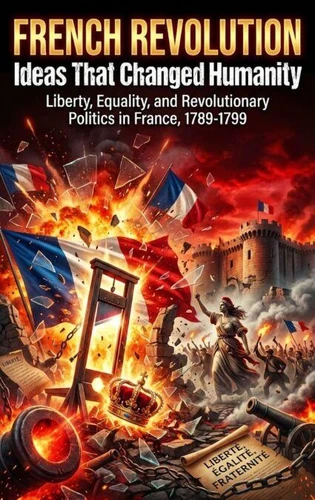
French Revolution: Ideas That Changed Humanity. Liberty, Equality, and Revolutionary Politics in France, 1789-1799
Par :Formats :
Disponible dans votre compte client Decitre ou Furet du Nord dès validation de votre commande. Le format ePub est :
- Compatible avec une lecture sur My Vivlio (smartphone, tablette, ordinateur)
- Compatible avec une lecture sur liseuses Vivlio
- Pour les liseuses autres que Vivlio, vous devez utiliser le logiciel Adobe Digital Edition. Non compatible avec la lecture sur les liseuses Kindle, Remarkable et Sony
 , qui est-ce ?
Notre partenaire de plateforme de lecture numérique où vous retrouverez l'ensemble de vos ebooks gratuitement
Pour en savoir plus sur nos ebooks, consultez notre aide en ligne ici
C'est si simple ! Lisez votre ebook avec l'app Vivlio sur votre tablette, mobile ou ordinateur :

- Nombre de pages252
- FormatePub
- ISBN978-3-565-25090-5
- EAN9783565250905
- Date de parution16/02/2026
- Protection num.pas de protection
- Taille2 Mo
- Infos supplémentairesepub
- ÉditeurEmphaloz Publishing House
Résumé
In 1789, France erupted in revolution that would reshape political consciousness across continents. What began as fiscal crisis and aristocratic resistance transformed into radical reconstruction of society, declaring universal rights while unleashing unprecedented violence. This history examines how revolutionary ideas-liberty, equality, popular sovereignty-emerged from Enlightenment philosophy and political crisis to redefine the relationship between citizens and state.
Drawing on legislative debates, pamphlets, personal correspondence, and eyewitness accounts, the narrative traces the revolution's escalating radicalism.
The Estates-General became the National Assembly, abolishing feudal privileges and proclaiming the Declaration of the Rights of Man and Citizen. Constitutional monarchy gave way to republic. The Terror institutionalized violence in defense of revolutionary virtue. War with European monarchies accelerated internal conflict. Factions competed for power-Girondins, Jacobins, sans-culottes-each claiming to embody popular will. The book explores key turning points: the storming of the Bastille, the march on Versailles, the king's flight and execution, Robespierre's rise and fall, the Thermidorian Reaction.
It examines revolutionary institutions-citizen armies, revolutionary tribunals, the calendar reform, dechristianization campaigns-and how ordinary people experienced upheaval through food shortages, assignat inflation, and constant political mobilization. Beyond France's borders, revolutionary principles inspired independence movements, constitutional reforms, and debates about natural rights that continue shaping modern politics.
Yet the revolution's legacy remains contested-democracy and dictatorship, emancipation and exclusion, reason and fanaticism intertwined throughout its tumultuous decade.
The Estates-General became the National Assembly, abolishing feudal privileges and proclaiming the Declaration of the Rights of Man and Citizen. Constitutional monarchy gave way to republic. The Terror institutionalized violence in defense of revolutionary virtue. War with European monarchies accelerated internal conflict. Factions competed for power-Girondins, Jacobins, sans-culottes-each claiming to embody popular will. The book explores key turning points: the storming of the Bastille, the march on Versailles, the king's flight and execution, Robespierre's rise and fall, the Thermidorian Reaction.
It examines revolutionary institutions-citizen armies, revolutionary tribunals, the calendar reform, dechristianization campaigns-and how ordinary people experienced upheaval through food shortages, assignat inflation, and constant political mobilization. Beyond France's borders, revolutionary principles inspired independence movements, constitutional reforms, and debates about natural rights that continue shaping modern politics.
Yet the revolution's legacy remains contested-democracy and dictatorship, emancipation and exclusion, reason and fanaticism intertwined throughout its tumultuous decade.