Artificial intelligence can now produce polished essays, solve standard problems, organize arguments, and generate formally correct answers in seconds. As a result, many traditional exams no longer reveal what instructors believe they reveal. A correct answer may demonstrate genuine understanding. It may also reflect skilled delegation to an external system. When the final product no longer shows clearly how it was produced, assessment loses its ability to distinguish between students who understand and students who merely submit plausible output.
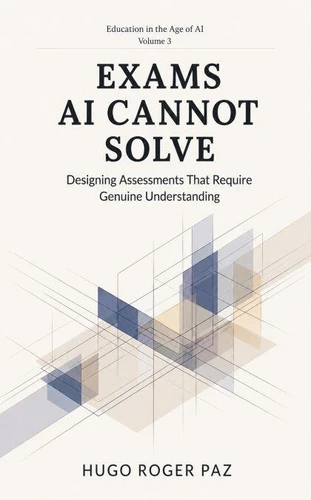
Exams AI Cannot Solve addresses this problem from a practical and pedagogical perspective. Its purpose is not to help instructors detect artificial intelligence, intensify surveillance, or design impossibly difficult questions. It proposes something more rigorous: redesigning assessment so that success requires the kinds of intellectual work that cannot simply be delegated. The book develops three central criteria for assessment in the age of AI:.
Formulation: Can the student define the problem, identify its assumptions, and recognize its constraints?. Interpretation: Can the student explain what a result means, where it applies, and what conclusions can reasonably be drawn from it?. Validation: Can the student evaluate the quality of an answer, detect errors, justify decisions, and defend the result through independent judgment?Through conceptual analysis, practical examples, redesign strategies, and directly applicable tools, the book examines oral defenses, process evidence, decision logs, traceable assignments, situated problems, error analysis, and assessment formats focused on genuine understanding.
Written primarily for university instructors, secondary educators, academic leaders, and professionals concerned with educational quality, this volume offers a clear alternative to both technological enthusiasm and defensive prohibition. The central argument is simple: the purpose of an exam is not to prove that a student did not use AI. It is to provide credible evidence that the student learned.
Artificial intelligence can now produce polished essays, solve standard problems, organize arguments, and generate formally correct answers in seconds. As a result, many traditional exams no longer reveal what instructors believe they reveal. A correct answer may demonstrate genuine understanding. It may also reflect skilled delegation to an external system. When the final product no longer shows clearly how it was produced, assessment loses its ability to distinguish between students who understand and students who merely submit plausible output.
Exams AI Cannot Solve addresses this problem from a practical and pedagogical perspective. Its purpose is not to help instructors detect artificial intelligence, intensify surveillance, or design impossibly difficult questions. It proposes something more rigorous: redesigning assessment so that success requires the kinds of intellectual work that cannot simply be delegated. The book develops three central criteria for assessment in the age of AI:.
Formulation: Can the student define the problem, identify its assumptions, and recognize its constraints?. Interpretation: Can the student explain what a result means, where it applies, and what conclusions can reasonably be drawn from it?. Validation: Can the student evaluate the quality of an answer, detect errors, justify decisions, and defend the result through independent judgment?Through conceptual analysis, practical examples, redesign strategies, and directly applicable tools, the book examines oral defenses, process evidence, decision logs, traceable assignments, situated problems, error analysis, and assessment formats focused on genuine understanding.
Written primarily for university instructors, secondary educators, academic leaders, and professionals concerned with educational quality, this volume offers a clear alternative to both technological enthusiasm and defensive prohibition. The central argument is simple: the purpose of an exam is not to prove that a student did not use AI. It is to provide credible evidence that the student learned.


 , qui est-ce ?