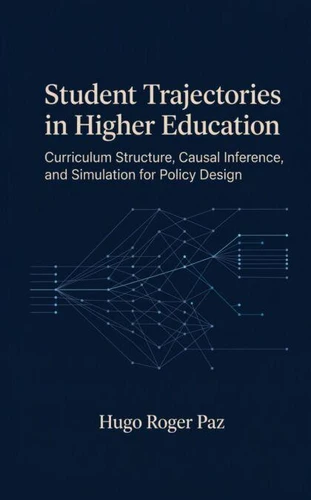
Student trajectories are not produced by students alone. They emerge from the interaction between individual characteristics, curriculum structure, institutional rules, and context. Student Trajectories in Higher Education presents CAPIRE, an integrated framework for analysing curriculum-constrained student trajectories through leakage-aware data design, curriculum graph modelling, trajectory heterogeneity, causal inference, and agent-based simulation.
Using a Civil Engineering programme in Argentina as an illustrative institutional case, the book shows how prerequisite structures, bottlenecks, progression rules, accumulated delay, and contextual disturbances can be incorporated into a coherent analytical architecture. The empirical results are deliberately treated as context-specific. What the book proposes as transferable is the analytical logic: a curriculum-aware approach that institutions can adapt to their own programmes, datasets, and regulatory environments through local calibration.
The volume is intended for researchers and practitioners in higher education analytics, engineering education, institutional research, curriculum analysis, educational data mining, and evidence-informed academic policy.
Student trajectories are not produced by students alone. They emerge from the interaction between individual characteristics, curriculum structure, institutional rules, and context. Student Trajectories in Higher Education presents CAPIRE, an integrated framework for analysing curriculum-constrained student trajectories through leakage-aware data design, curriculum graph modelling, trajectory heterogeneity, causal inference, and agent-based simulation.
Using a Civil Engineering programme in Argentina as an illustrative institutional case, the book shows how prerequisite structures, bottlenecks, progression rules, accumulated delay, and contextual disturbances can be incorporated into a coherent analytical architecture. The empirical results are deliberately treated as context-specific. What the book proposes as transferable is the analytical logic: a curriculum-aware approach that institutions can adapt to their own programmes, datasets, and regulatory environments through local calibration.
The volume is intended for researchers and practitioners in higher education analytics, engineering education, institutional research, curriculum analysis, educational data mining, and evidence-informed academic policy.