Nouveauté
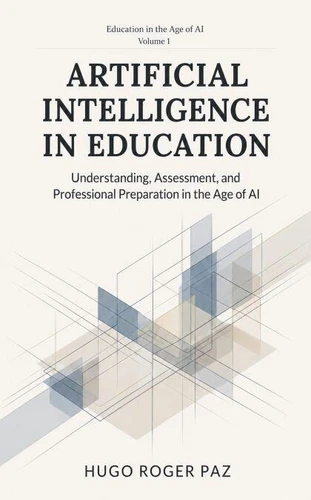
ARTIFICIAL INTELLIGENCE IN EDUCATION Understanding, Assessment, and Professional Preparation in the Age of AI. Education in the Age of AI, #1
Par :Formats :
Disponible dans votre compte client Decitre ou Furet du Nord dès validation de votre commande. Le format ePub est :
- Compatible avec une lecture sur My Vivlio (smartphone, tablette, ordinateur)
- Compatible avec une lecture sur liseuses Vivlio
- Pour les liseuses autres que Vivlio, vous devez utiliser le logiciel Adobe Digital Edition. Non compatible avec la lecture sur les liseuses Kindle, Remarkable et Sony
 , qui est-ce ?
Notre partenaire de plateforme de lecture numérique où vous retrouverez l'ensemble de vos ebooks gratuitement
Pour en savoir plus sur nos ebooks, consultez notre aide en ligne ici
C'est si simple ! Lisez votre ebook avec l'app Vivlio sur votre tablette, mobile ou ordinateur :

- FormatePub
- ISBN8235922358
- EAN9798235922358
- Date de parution22/07/2026
- Protection num.pas de protection
- Infos supplémentairesepub
- ÉditeurIoakim Ioakim
Résumé
Artificial intelligence is already changing how students read, write, solve problems, prepare assignments, and demonstrate what they know. The real question is no longer whether AI belongs in education, but how education must change now that cognitive work can be assisted, accelerated, or partially externalized. Artificial Intelligence in Education examines that transformation with a clear argument: AI should neither be celebrated uncritically nor resisted nostalgically.
It must be governed through sound pedagogy, rigorous assessment, professional judgment, and institutional responsibility. The book explores what it still means to understand when correct execution is no longer sufficient evidence of learning. It analyzes the limits of traditional assessment, the risks of confusing plausible output with genuine understanding, and the growing importance of problem formulation, interpretation, validation, and intellectual responsibility.
It also introduces the concept of augmented modeling as a framework for rethinking learning in contexts where formal execution may be supported by digital tools, while conceptual control and accountability remain nondelegable. Across chapters on assessment, AI tutoring, engineering, medicine, law, nursing, teacher education, and institutional governance, the book shows how AI affects different professional fields and why each must redefine what students are expected to understand, justify, and defend.
Written for university instructors, secondary educators, academic leaders, institutional decision-makers, and professionals interested in the future of education, this volume offers a rigorous and practical framework for responding to AI without lowering standards or surrendering human judgment. The central challenge is not technological adoption. It is educational redesign.
It must be governed through sound pedagogy, rigorous assessment, professional judgment, and institutional responsibility. The book explores what it still means to understand when correct execution is no longer sufficient evidence of learning. It analyzes the limits of traditional assessment, the risks of confusing plausible output with genuine understanding, and the growing importance of problem formulation, interpretation, validation, and intellectual responsibility.
It also introduces the concept of augmented modeling as a framework for rethinking learning in contexts where formal execution may be supported by digital tools, while conceptual control and accountability remain nondelegable. Across chapters on assessment, AI tutoring, engineering, medicine, law, nursing, teacher education, and institutional governance, the book shows how AI affects different professional fields and why each must redefine what students are expected to understand, justify, and defend.
Written for university instructors, secondary educators, academic leaders, institutional decision-makers, and professionals interested in the future of education, this volume offers a rigorous and practical framework for responding to AI without lowering standards or surrendering human judgment. The central challenge is not technological adoption. It is educational redesign.