Nouveauté
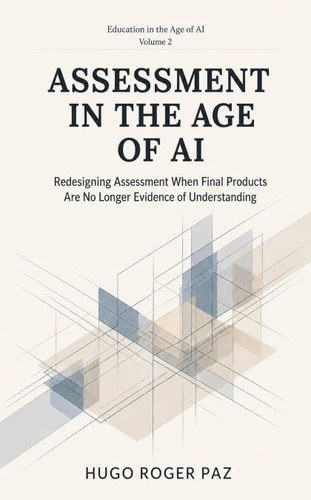
ASSESSMENT IN THE AGE OF AI Redesigning Assessment When Final Products Are No Longer Evidence of Understanding. Education in the Age of AI, #2
Par :Formats :
Disponible dans votre compte client Decitre ou Furet du Nord dès validation de votre commande. Le format ePub est :
- Compatible avec une lecture sur My Vivlio (smartphone, tablette, ordinateur)
- Compatible avec une lecture sur liseuses Vivlio
- Pour les liseuses autres que Vivlio, vous devez utiliser le logiciel Adobe Digital Edition. Non compatible avec la lecture sur les liseuses Kindle, Remarkable et Sony
 , qui est-ce ?
Notre partenaire de plateforme de lecture numérique où vous retrouverez l'ensemble de vos ebooks gratuitement
Pour en savoir plus sur nos ebooks, consultez notre aide en ligne ici
C'est si simple ! Lisez votre ebook avec l'app Vivlio sur votre tablette, mobile ou ordinateur :

- FormatePub
- ISBN8235700376
- EAN9798235700376
- Date de parution22/07/2026
- Protection num.pas de protection
- Infos supplémentairesepub
- ÉditeurIoakim Ioakim
Résumé
Artificial intelligence has changed the conditions under which students produce academic work. A polished essay, a correct technical solution, or a well-structured report can no longer be treated automatically as reliable evidence of understanding. Assessment in the Age of AI examines what this change means for university assessment and what instructors can do about it. The central problem is not simply cheating, plagiarism, or unauthorized tool use.
It is more fundamental: when final products can be generated or substantially assisted by artificial intelligence, traditional assessment formats lose part of their ability to distinguish genuine understanding from plausible output. This book argues that the answer is neither prohibition nor technological surveillance. It is assessment redesign. Drawing on research, educational practice, and examples from different disciplines, Hugo Roger Paz explains how instructors can move beyond exclusive reliance on final products and construct stronger evidence of learning.
The book develops practical criteria for evaluating formulation, interpretation, justification, validation, process traceability, and independent judgment. Readers will find:. an analysis of why inherited assessment formats are becoming less reliable;. a clear distinction between academic dishonesty and poor assessment design;. alternatives to AI detection and restrictive policies;. strategies for oral defenses, decision logs, process portfolios, and second-order tasks;.
guidance for designing rubrics that assess understanding rather than polished production;. criteria for using AI as an assessment assistant without delegating instructor judgment;. applied cases from the humanities, engineering, health sciences, and graduate education;. practical prompts and tools for redesigning existing assessments. Written for university instructors, secondary-school teachers, academic leaders, and professionals concerned with the future of education, this volume offers a rigorous and practical framework for answering a decisive question: what should count as evidence of understanding when producing an acceptable answer is no longer difficult?
It is more fundamental: when final products can be generated or substantially assisted by artificial intelligence, traditional assessment formats lose part of their ability to distinguish genuine understanding from plausible output. This book argues that the answer is neither prohibition nor technological surveillance. It is assessment redesign. Drawing on research, educational practice, and examples from different disciplines, Hugo Roger Paz explains how instructors can move beyond exclusive reliance on final products and construct stronger evidence of learning.
The book develops practical criteria for evaluating formulation, interpretation, justification, validation, process traceability, and independent judgment. Readers will find:. an analysis of why inherited assessment formats are becoming less reliable;. a clear distinction between academic dishonesty and poor assessment design;. alternatives to AI detection and restrictive policies;. strategies for oral defenses, decision logs, process portfolios, and second-order tasks;.
guidance for designing rubrics that assess understanding rather than polished production;. criteria for using AI as an assessment assistant without delegating instructor judgment;. applied cases from the humanities, engineering, health sciences, and graduate education;. practical prompts and tools for redesigning existing assessments. Written for university instructors, secondary-school teachers, academic leaders, and professionals concerned with the future of education, this volume offers a rigorous and practical framework for answering a decisive question: what should count as evidence of understanding when producing an acceptable answer is no longer difficult?